Our Fourth Winter Begins

Fight the darkness

It is a stunning realization – we have begun our fourth winter since the husband’s diagnosis of Lewy Body Dementia, LBD. It is hard to say if the things we have done since September 2018 have been the right things, or have been done consistently or for long enough time. It’s just hard to imagine that one could quickly change the course of a disease that’s been in progress for many years. We may not have stopped it in its tracks, but it is clear that our journey is different from most others, so far.

LBD quickly becomes a story told by the caretaker. I remember attending a conference for LBD patients and their spouses/caretakers at Mayo Clinic in 2019 where a patient was one of the main speakers. He did a good job. I wonder how he is now. I have a feeling he was a rare case.

My Dennis used to think and talk about the book he was going to write telling his experience with LBD, and his reversal of the disease, of course. That doesn’t get mentioned anymore. He doesn’t write anything, and sometimes has trouble signing his name. A book is not the kind of project he would have been motivated to finish even when he was well, so it is not surprising to me that it has never even been started. Talking has always been his mode of communication. LBD has not changed that.

He has cognitive deficits that he is aware of, but his personality is intact. His curiosity and desire to learn is still there. His need to teach and share what he knows is still prevalent. He surprised us all over the Thanksgiving holiday by having some fairly deep conversations with several people, in which he almost seemed normal in a “pre-Lewy” way. He listens every morning when we read. He asks intelligent questions and makes reasonable comments. But prolonged thinking tires him out and he no longer tries to convince, debate or argue his points.

I left this morning to take Mom to an early doctor appointment. Dennis was listening to a favorite podcast and started to tell me something he thought was very important, which I didn’t have time to hear. When I asked him at lunch what the important thing was, he couldn’t remember it. He said he was having more trouble with his memory again. It did finally come to him, but he had to ask me to find the podcast for him on his phone and play it over.

*******************************************************************************

I’ve been gone most of the day, taking mom to appointments and for groceries. He sits in his lift chair, silence in the room – a rare occasion. I ask him what’s on his mind, and does he need socialization, from me. He says “no”. He’s thinking about a sermon he heard earlier on TV. I don’t believe him. I sit down and tell him about my day and read to him.


Being “Right” Comes Full Circle

(It has been suggested by the husband that I write this to his daughters. He has Lewy Body Dementia, and once in a while, it adds to life instead of just taking away.)

We were reading a thoughtful paragraph on humility this morning, referencing people who are always right about anything and everything. Dennis laughed and said something that our youngest daughter had said to him once. “I am right, because I am a Dietz!” It was said tongue in cheek and they laughed at it at the time too. Then he got quiet and continued, “I love our daughters so much. I hope they know that.”

It was a special moment and we continued talking about the meaning of that conversation and why the memory of it sparked such gratitude and love inside his “dad heart”.

During the years our daughters were growing up at home there were so many good times for us as parents and for them as children. There were also times, not so good, when they felt distanced from their parents. The role of provider was always of high concern for Dennis, and required a lot of his attention. Maybe small people (children), having limited experiences, were not as interesting as other friends and business associates. He never intentionally conveyed this to them, but it was conveyed nonetheless.

In addition it was natural to assume that children’s opinions, reasons, and thought processes were still to be directed and molded, not listened to and considered. This attitude also was never intentionally spoken, nor was it applied 100% of the time, but over the years it was felt, sometimes acutely. Although Dad provided well and loved them, he didn’t know them personally and was often clueless as to what they were feeling. Perhaps they heard more of “don’t leave toothpaste in the sink” and “your lights were left on – go turn them off” than the things daughters need to hear from their dads.

So what does it mean when a daughter can tease, laugh and point out some hurtful flaw when talking to her dad? What did it mean that she could remind him of that “always right” attitude in a gentle conversation (well, I don’t actually know how gentle it was or what it was about because I wasn’t there…)? To him, it meant forgiveness. It meant that she wasn’t afraid to remind him of that proclivity of his. It was acknowledgement and grace extended. And it was love.

The husband has mellowed so much in the last few years. Retirement has put the distraction of being a provider behind him. He fully realizes those things he has missed by not being more aware, more curious, more persistent about knowing his children. He has also been diagnosed with a heartbreaking condition. But it has turned into a blessing. It’s almost as if his heart had to be broken in order for him to know what was in it. It’s amazing to think about.

Although he is disabled, he has traveled long distances to see each of his two daughters get married, during pandemic times. He would not have missed these opportunities for the world. “Being right” has come full circle and is now much more like “Being in love.”

It provides hope for us all. We can grow, learn, change. The whole story doesn’t have to be pretty for the outcome to be good. God be praised for his transforming power, his gentleness and his wisdom, and his mysterious ways.

What Hope Can Do

I haven’t recorded all the things that Dennis has gotten through lately, and since they are remarkable they should be recorded.

We’re in a stage where the doctors seem to be done with him. No one is checking him or recommending new treatments. He has discontinued some of the supplements that didn’t seem to have much effect, but were costing a lot of money. It could be viewed as a discouraging time, but he remains outwardly hopeful and unperturbed.

He was a little unsure about the travel we had planned for the second half of July – it was ambitious. We went from our home in Wisconsin to Seattle, by car for “wedding week”. He wanted very much to be present to see this daughter get married so he did what he could to prepare, and tried not to put any trouble in the mix of all we had to do.

We spent five days driving out, in which we learned to get in and out of hotels, restaurants and restrooms with all our “stuff”. It was very different from being at home and I was unsure what that would do to him, but he adapted. There were a lot of times when the challenge of steps, inclines, small spaces, and long hours made him very tired. We had a wheelchair/walker with us but by the end of wedding week and the four day return trip, he was riding in the wheelchair most of the time. I was very worried that he might fall.

It was a good trip. We were relieved and amazed to be back home after two weeks away. He has recovered and not experienced any lasting changes from all the unusual routines. I thank God every time I think back on this time.

Yesterday morning, praying about the day ahead, God and I came to an agreement. Our new son-in-law’s parents were coming for their first visit to our town and I had arranged with a friend for a boat ride on our favorite lake. I knew it would be kind of weird for Dennis not to be there with us, but I questioned whether we could get him in the boat easily. Even he had said he would just stay home because it sounded hard. We had done this same excursion two years ago with different friends and it had been hard then. He has declined a lot since.

Back to the agreement. I felt that I should ask Dennis again if he wanted to go on the boat, and if he did we would plan on it and God would help us. As I suspected, Dennis wanted to go. Here’s how it went down.

We arrived at “Lunch on the Lake” and talked with Mr. Jacobsen. He allowed us to drive down the steep embankment, on their lawn, to get near their boat dock. Dennis used his walker to finish the distance and get out on the long narrow dock. It took a great deal of coaching and encouragement from all five of us to tell him where to hang on, which part of him to move next, how high to lift his feet, when to duck under the boat awning, etc… , and we were ready to catch him at any moment if we had to, but he made it. It was remarkable because this is a guy who often has trouble just getting in bed.

There he is, in the boat.

We had a good hour long boat ride and a nice lunch with our guests before we had to repeat the whole process in reverse. I think we all had a sense of accomplishment when it was over and we were in the car again. We did a little more sightseeing with him riding in the wheelchair, and by the time company left, he was ready for his overdue nap.

But, can you see what hope can do? Sometimes God gives us challenges and wants to see what we will do with them. With the challenge, he promises to help, to teach, to show up in some way to demonstrate remarkable things. I am so thankful we are not on this journey alone.

This guy. Hopeful.

Telephone Tribe

I’ve just read a post in the online support group for dementia caretakers that made me think. It was about how those with a diagnosis of LBD, who have been good friends with many in better years, don’t hear from their friends any more. Actually it was a caretaker writing the post, who was sad that the friends didn’t even contact her to ask how her husband was. She was wondering what their excuses were. Were they unable to handle the changes they saw in him? Were they afraid dementia was contagious, or that they would somehow get it? Did they think that their absence wouldn’t be noticed by anyone so why bother?

My husband who has Lewy Body Dementia is probably not your typical dementia victim, because he has refused to let people forget him. He calls them up if he knows their number. He hunts them down if he doesn’t know their number. He calls them again if they don’t answer the first, second, or third time he calls. He checks up on them even if they don’t check up on him. He remembers what they’ve talked about. These people are his past business associates, the members of the band he used to play in, and family members.

Many times I’ve listened to the conversations (he is always in the living room and doesn’t try to keep them private). Sometimes I cringe when I hear him repeating the same story to someone who has heard it all before. Sometimes I feel sorry for the person he calls because he talks so slowly and often has trouble hearing. Sometimes I wish he wouldn’t try to sound like an authority about other people’s problems, or misquote things he’s read, or be so simplistic about things I think are much more complex. But at the end of it all, I see that there are those people who do take his calls anyway. There are some who listen to his stories, even if somewhat impatiently, and respond with interest. Some tell him that he has encouraged them, given them hope. They are his telephone tribe.

I hear patience in their voices when they talk to him, laugh with him, ask him questions. When they don’t have time for his hour long versions, they tell him they need to go in a few minutes. They set limits in kind ways and show respect. They call him back when they say they will or apologize if they forget. They continue being good friends. They know they are doing something for him that friendship is supposed to do, and they are not afraid, not too busy, not “turned off” by the changes dementia has brought to him. I am so thankful for those friends, because they also help me. I am thankful to have married a man who chose his friends wisely. If you are this kind of friend, thank you.

The New Chair

Dennis has been getting more receptive to equipment that makes movement easier for him. He always used to say no to those things, thinking that he should continue to do everything the hard way, under his own steam, because it was “exercise”. But now his slowness and instability make it hard for me to take him places, even close places like Mom’s house, or to my brother’s which is easy walking distance (for anyone but Dennis).

So the first concession was to start using a walker. We had a low end model but he found it hard to go over uneven sidewalks because the walker had only two wheels and the other contact with the ground was just aluminum legs which often got hung up. I guess that’s why people buy tennis balls and stick them on the legs.

Then he discovered Mom’s fancy convertible wheelchair, which can be used as a walker and also has a seat. It is extra security when he gets tired and needs to rest. He hardly ever goes far enough to need to rest, but that is beside the point. The seat is there and ready.

Yesterday, he broke down and said he needed a lift chair. We had been noticing the increased struggle getting out of recliners. He loves to spend most of his time in that type of chair but it would take him a half dozen attempts to raise out of one. He has very little strength in his thighs. At the same time he had been having frequent urges to get to the bathroom which was not good when he was stuck in his chair. He had tried Mom’s lift chair last week and found it quite impressive. He wanted one.

There two furniture stores in Hayward – the expensive one and the less expensive but still horrifying one. In the lesser store I found two chairs, both of which were just a bit under $2000. They also looked huge and I am not a fan of huge, heavy furniture anymore. I didn’t even bother with the expensive store. Instead I went to Facebook marketplace and inquired about three that were within reasonable driving distance. This morning I borrowed my brother’s truck, picked up a strong helper and drove an hour away to Ashland and fetched home a chair. The upholstery is in great shape, and it only cost a quarter of what a new one would cost. I could be happier about the electronics which are a bit confusing, but it does a nice powered recline and it does eject him satisfactorily. There was no place to plug it in for a test at the storage facility where we picked it up.

I don’t know, it seems really big to me…

I think he’s happy tonight. He likes it (thankfully). It’s a comfortable chair, although I’ve only kind of sat in it once. It’s quite a piece of furniture, with a “presence” all its own. I’m afraid it might even have a personality. It might need a name. At the very least it calls for a living room re-arrange, since it looks really weird in its heightened position, waiting for its occupant. I’m hoping to dream something up while I sleep tonight. I’ll find a good place for it. Welcome Mr. Chair.

Can You Get This Off My Phone?

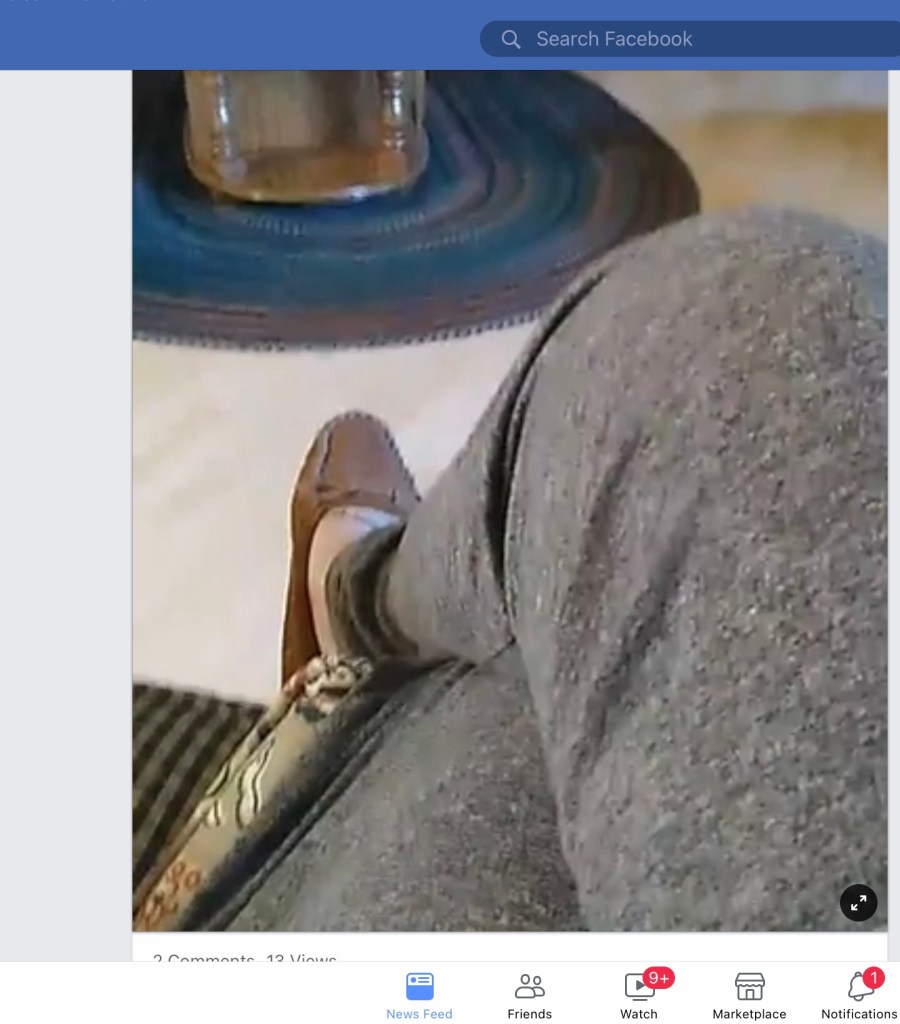
Today the husband came to me in my “girl cave” wanting to know if I could fix something on his phone. He had inadvertently taken a video of his knee and posted it on Facebook. A fairly complicated accident, if you ask me. There were already two comments on it from friends, which was nice, but he hadn’t seen them yet. Instead he was frustrated over an email ad offering to take down an unwanted photo from an unnamed site.

Is there some internet business just scrolling Facebook, finding weird videos, and marketing themselves as being able to solve some horrible problem? I don’t know. I just edited the Facebook post. I could have deleted it but the friend messages were nice and I thought he should keep them. But the episode made me wonder if he could find trouble with all he does on his phone…

Hey, why not? It’s a nice knee…

It is his dearest occupation – to watch/listen to podcasts and videos on his phone. It’s close, in his hand, and the screen is magnified to a size he can read. It talks to him and gives him things to think about. I don’t know what could replace it in his limited arsenal of things to do.

His inability to see things for what they are, such as advertisements, is constantly coming up in our conversations. He is very swayed by clever marketing and feels like he has “discovered” things by his “research”.

Lately he has been “researching” a problem my Mom has been having and is certain he can help her with it. Last night, when I had disappeared on a bike ride, he went over to Mom’s, uninvited, and was sitting talking with her when I stopped in. When I left to get a shower and go to bed, he didn’t want to come. He sat and talked until nearly 10 pm. I wasn’t sure if I should make him come with me, but I figured Mom could handle it if she wanted him to leave. She said he told a lot of old stories (no surprise there). Her comment was, “he doesn’t get bored when he’s doing the talking”. Not always the case with those who are listening. He didn’t remember to tell her about his research and wanted to try again today.

It’s sad. Sometimes it’s frustrating. But he is still interested in life. He’s kind, cooperative, funny, and really not that much more work than I’m used to anyway. And I have so many places to find joy that it amazes me. God is good, even (especially) in this phase of our lives. We are okay, at least until I can no longer figure out technology either…

And Then Again, Maybe Not…

I don’t think he had a stroke (see previous post). I think it was one of the expected fluctuations of LBD. For a day he had difficulty thinking fast enough to speak, and getting words out, but now he apparently has recovered. Last night he held a phone conversation without trouble and today he enjoyed a long talk with a new friend. I could see no effect from his temporary lapses.

I also asked him if he felt recovered, and he thinks yes, he has. He’s physically slow but mentally back to par (for him).

Just like his blood pressure has dramatic spikes, followed by strange lows, the other parts of his nervous system experience blips in their function. Sometimes it’s his eyesight, sometimes bowel function, often it’s coordinating his movements. I’ve heard it described as a roller coaster of symptoms and it does seem that way. We just don’t know what to expect next.

I think it does help to pray and have a positive attitude. I’m grateful it does not seem to be the “fall from the cliff” that I thought it might be.

A Bad Day and a Disturbing Change

May 29, 2021

A strange occurrence this week. The husband had a bad day which was noticed first when we went a few doors over to my brother’s house for a meal. He had a very hard time seeing things, like steps to go up or down, and food on his plate. He was very quiet at the meal but still conversed. Being very tired afterwards, he went for a nap.

When he woke up he was confused and couldn’t verbalize well. Words would come out of his mouth that he had no idea he had spoken, words that didn’t mean what he intended to say. He didn’t know why. He looked at me strangely all evening and acknowledged that something was very different and very wrong. He was slower in his movements but was able to get around okay, and seemed weak but symmetrical in his muscle tone.

His blood pressure was very high, something that had become common for him. His usual methods of bringing it down were not as effective, but as the evening wore on it did come down. LBD is known for erratic spikes in blood pressure in spite of medication.

I wondered if he had experienced a small stroke.

The next day he was not as “scary” in his reactions but still very bothered by his inability to think and verbalize. He concludes that some damage has been done and it may take a while for him to recover.

Even before this happened, his willingness to accept a wheelchair signaled a change. He has needed one the last couple of times we were seen by a doctor. He can’t stand in lines to wait at the clinic and has felt generally much weaker. He has stopped doing exercise except on rare occasions. He can’t walk very far and wants to have the walker in the car whenever we go somewhere. His overall appearance is of a very disabled man.

There are ups and downs, relapses and recoveries with LBD, but I would have to say that he has clearly progressed in the disease. He has not been making phone calls since having the speech trouble and that is sad because it was a lifeline for him. I’m hoping that he will improve in that area.

Good Advice, God’s Prompting

I frequently read posts in a caregivers group for Lewy Body Dementia. Tonight I was glad for the advice I commonly see there concerning changes in behavior. The advice is to always suspect urinary tract infection.

The last two or three days have been bad ones for Dennis. He has been weaker, sleeping more, hard to motivate, less interactive, not eating as well, not thinking as well. He needed a shower (smelled bad) and although he didn’t object to the idea, he would never get around to doing it. He would take a nap instead. He began having urinary incontinence problems and wanted to know where his Depends were. He would wake up with an urgent need for the bathroom, but would have so much difficulty getting there that he would have an accident. Finally he told me he had a burning sensation when he started to urinate, and the light in my brain came on. UTI.

Why do these things always happen on the weekend? Fortunately we do have an urgent care clinic at our hospital and I decided to take him there right away. He had to be talked into going – “I’ve had these kinds of problems for months” he said. But I told him we needed to find out and that it would be fairly simple to do, and that it would not be good to wait for an appointment during the week.

We were in an exam room within a few minutes after checking in. Vital signs showed normal blood pressure and temperature, so no fever. A urine sample was taken and an ultrasound of the bladder to see if there was more than usual residual. The results showed a lot of white cells (infection) and some blood in the urine as well. Before we went home he was given an injection of antibiotic, a prescription for 10 days of oral antibiotic and orders to check back in a couple of days.

I am so glad we are on to this! It could explain all the recent changes that have worried me. Hopefully the infection clears up and we won’t have to deal with worse complications like kidney stones or kidney infection.

I thank God for his promptings, for bringing things to mind, and for the appropriate sense of urgency to get care quickly. We ask for his help daily and he is good to us.

A New Season, Possibly

For the last two and a half years since diagnosis, changes have been gradual. Most of them have been physical and of a parkinsonian nature. The shuffling, tremor that started in the right hand and now affects both, sometimes a tremor in the legs, incredible slowness of movement, a blank facial expression – all those symptoms have been the most noticed. Even with these things, Dennis has been mostly independent. He moves himself from one place to the other, gets to the bathroom without help, puts himself to bed, gets a snack when he wants one, and makes decisions to go to church or the chiropractor or to visit Mom or my brother.

Cognitively, he is able to think and remember fairly well. He brightens up when talking with friends on the phone and carries on a meaningful conversation, although slowly. Sometimes he snaps into his scientific mind and amazes people. He has become focused on a few subjects, which he follows by listening to YouTube podcasts on his phone. He has a list of prophets that provide daily updates and he often listens to the same one several times.

He doesn’t spend as much time researching his own disease, although he runs across something every now and then. He is more centered on the supernatural, hoping for a better chance with God than he has noticed with medicine. The most recent therapy which he is still receiving is applied kinesiology which includes chiropractic, muscle testing, light therapy, nerve stimulation, cranial-sacral therapy, and tapping, all from the same practitioner who also prays with him.

He was alone at home for one week in April while I took Mom to Florida for a memorial and family visit. He had my brother and Lurae, a neighbor, looking in on him and providing meals. He seemed to be fine with that. My brother remarked that he perhaps did things better than he does when he’s being waited on all the time.

But I think I notice, following that week, a tendency to sleep more during the day, and not as well at night. It looks a lot like depression, and why would it not? There is so little he feels he can do except listen to his phone. That gets tiring so he goes and takes a nap.

Last night he could not tell what the food on his plate was. He was trying to cut it up as if it was chicken, but to his surprise it was salmon. He had a lot of trouble getting food on his fork and reverted to using his fingers to eat the fish and green beans, which is okay with me, but messy. He took a spoonful of cranberry relish and thought he was putting it on his plate but no, he was purposely putting it on a napkin that he thought was his plate. I think the whole mealtime experience devastated him. When I asked if he was having more trouble with his eyes he said yes, and that he thought it was probably his brain rather than his macular degeneration getting worse. He was very resigned and quiet about it.

My question is, are we heading into a period of more noticeable changes that are taking away vital functions? I hope he will still be able to travel to our daughter’s wedding in July. He was so looking forward to that.