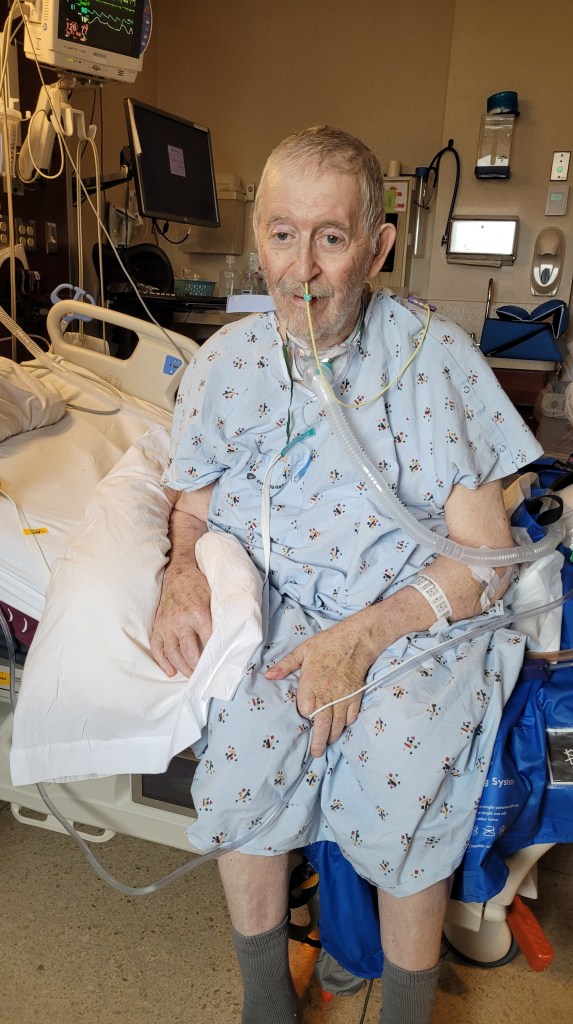
Occupational Therapy, clothes on, in a chair, ready for work. Thumbs up.
Progress Points: Week One in Rehab
New routines are getting in place at Miller Dwan Rehab Hospital.. OT early in the morning to get dressed, brush teeth, ADLs. Speech therapy. Off to the gym for an hour with PT and then back to rest. OT and Speech again in the afternoon. Evening rest.
Off oxygen and still doing well.
Blood pressure remaining stable.
No more finger pricks for blood sugar testing.
On a new mattress that avoids painful pressure points.
Allowed to sleep at night, undisturbed if he doesn’t need anything.
Beard got trimmed (yay!). Wearing real clothes during day.
Having real conversations with wife. Voice getting stronger.
Getting “known” by staff.
Got to ride stationary bike in PT, with help.
Room got personalized – the “love” poster from family and all the cards are on the wall where they can be seen.
Sayings
When told rehabbing was his new job: “Take this job and shove it.”
Dennis has a new job. I hope he’s up for it because it won’t be easy or short term. His job is surviving rehab.
Yesterday I made my way from the parking garage at St. Mary’s Medical Center, across the skywalk to Miller Dwan Rehab Center. Finding my way in a new place is always an adventure. Knowing and following all the rules challenges me, especially since Covid. Hospitals are built with mazes as their model and so many of the halls look the same. And it’s not like they have a lot of restrooms for the public either. I drive 90 miles to get to Duluth so I make it a point to find them.
A rehab hospital is an entirely different experience from an acute care hospital. I was so relieved at the quietness, low key atmosphere, soft voices and lack of hurry. The husband has a small private room with glass sliding doors, and it’s right in front of a nurses’ desk. He has a window and a nice bathroom. Since he still needs a lot of care, all the regular hospital extras are there – oxygen, suction, monitors and computers, lifts and a fancy bed.
The social services worker assigned to Dennis talked with me, both to get information about our home situation for eventual discharge, and to give information about his stay. We already knew he would be getting about three hours of therapy per day from physical therapy (PT), occupational therapy (OT) and speech language therapy (SLT). There will also be talks with psychologists, chaplains, social workers and of course, the doctors. They all meet weekly on Tuesdays and evaluate each patient’s progress. The social worker promised to give me a report each Tuesday after their meeting.
At this point, they estimate Dennis will be with them for 60 days. I am not surprised that it could take a long time because Dennis is at zero on the independence scale right now. I am surprised and relieved that they are willing to take him for that long as it will give me time to prepare for where he goes next. I am hoping our insurance will cover that amount of time. I haven’t checked yet, and I guess that will be my new job.
Good to be wearing T-shirt and pants again.
No time was wasted by the therapists. They have all had two or three sessions with him during these last two days, mostly to evaluate and set up their plan. He is an exhausted guy and it worries me to see him looking and acting so very tired. Before the stroke he was walking, talking, feeding himself and doing many of his daily activities without help, but I also have to admit that he was already tired and taking frequent naps. What kind of improvement can we even hope for now, given all that he’s been through in the last four weeks? But this is humanly thinking and I thank God that we are not limited to that.
I can tell that Dennis has had a lot of time to think, at night especially. He is often uncomfortable, or cold, or sore from his position which he cannot change himself, and unable to find his call button to get help. As his mind clears he is more aware of his predicament and has started looking for someone to blame. He has landed on himself.
“If only I hadn’t been so stubborn about wanting to do it my way. I didn’t want to take those blood pressure meds. This is all my fault. ” I did my best to talk him out of that one, reminding him that even when he took the pills he had alarming hypertensive spikes, followed by hypotensive lows that nearly made him pass out. But, I totally get what he’s feeling because I also went down that road, feeling that I should have made him take his meds. It could easily be my fault too.
When one of the therapists asked how far I was driving and how often I came, he remarked “I don’t know why she stays with me.” I have never heard him say anything like that before and was actually a bit shocked to hear it. I told him I was sticking around until January because I wanted to be able to say I’d been married for 50 years, then I’d be leaving. Did he laugh? I couldn’t tell.
So you see, he is having to deal with some heavy emotions. He hasn’t been one to admit to depression, even since the Lewy Body dementia diagnosis. I am hoping some of the rehab deals with the natural depression that anyone would feel if they suddenly became weak, helpless and out of control in every way. And I will be reminding him to look ahead as God guides him into a purposeful future.
I thought the surprises were over, but they were not.
Today when I arrived at Dennis’s bedside I was able to see his face without the NG tube. The nurses had already taken care of that task. A good thing.
Dennis’s face… he has lost weight in his face and looks so tired. The husband has very big eyes, hound dog eyes, you might say. When he looks at me, or other people, with recognition in those eyes, and maybe a lifting of the eyebrows in question mode, he sparkles with personality. When he has his eyes closed, or half closed as they often are, he looks near death. He doesn’t always show a lot of facial expression – it’s one of the parkinsonism traits of Lewy Body dementia. Another feature of his face is the month old beard and mustache. I’ve held off trying to shave him for fear some hair might be sucked into his trach tube.
The next thing we heard from one of the nurses was that he was being transferred to rehab today! Probably this morning! A day earlier than expected! His first feeding in the new gastrostomy tube was started and a few minutes later PT was knocking on the door to work with him. They were all excited and wanted to see if he could stand with their fancy lift machine.
The stand up machine. Took 10 minutes to get in place, 5 seconds to stand up.
The doctor came next, then the social worker who had been helping with placement. It was like a celebration with everyone smiling and congratulating us. It was like having a new baby, or maybe winning the lottery.
I actually felt guilty leaving before the move occurred. I had a much needed massage scheduled and had barely enough time to get home for it. I’ve missed a lot of self care lately (showers, hair cuts, sleep, etc…) and decided that there were competent people who would take good care of Dennis during the transfer. And they did. I called this evening and he was in his new room, doing fine, according to the nurse.
Tomorrow I will have a new adventure, finding my way through a new facility, getting used to new regimens and rules. Dennis has always thought that trying to get well was his new post-retirement job but I have a feeling this will be the most work he has done in a long time. The list of scheduled appointments is long.
I know enough not to get haughty and demanding with God. On my walk yesterday evening I had asked only for some small encouragement, something to keep us in the game and give us direction, some small arrow to shoot at the complex discouraging problems in view. I felt a plan was in place, even if I didn’t know the details. I trusted we would be helped, based on the character of my God. And now I will acknowledge his actions on our behalf, because that is what is due.
When I arrived at the hospital on Wednesday morning, Dennis was already back from Interventional Radiology and the feeding tube was in place. It had gone perfectly. However the nasogastric tube was still in place also and would have to stay there, hooked to his nose, for another 24 hours before it could be taken out. We decided to allay our disappointment with a little work.
I fed him ice chips and started his exercises, moving every part of him that would move. He was just finishing this when PT came to the room. The day before I had told the attending doctor that he had been alert all day and had scratched his own nose. He had talked to her and remembered her name. She had been impressed and had asked for him to be re-evaluated. The PT girls had him sit up on the side of the bed, and they too were impressed by his responses. Then Occupational Therapy came and had him brush his own teeth with a sponge stick, and a few other small maneuvers. Another point for the man. Speech Therapy came next and had him do a bunch of swallowing exercises. This was a busy morning for someone who had been nearly comatose for several weeks.
First time sitting up in a looooong time. It felt good. Still have a few tubes to get rid of though.
But wow, did it ever pay off! The attending doctor came in the afternoon and said Dennis was going to acute in-patient rehab at Miller Dwan, the best in the area. It’s connected to the hospital via skywalk. He would probably be able to go on Friday. Whereas he had not been a candidate for it previously, they now felt they had something to work with and were going to give him a second chance. I was ecstatic. Dennis was worn out but I think he was catching on that a good thing had happened.
We talked about it (I talked about it) the rest of the afternoon as he practiced swallowing ice chips. So even though he still had the NG tube for another night, it felt like the day had gone gloriously well. He had been a trouper and had worked hard. I had been a good coach and advocate.
I left to stay overnight with a friend who lived a few miles away, feeling oh so grateful and amazed at such a turn of events.
I have no hospital picture for today. Instead I took this shot of our meadow while walking, thinking and praying about handling disappointment. Sights like this speak God’s goodness to me.
Today Dennis was supposed to have a PEG tube for feeding inserted into his stomach – a procedure done in the radiology department under light anesthesia. It didn’t happen.
I had explained what it was and why it would be better than the nasogastric tube he’s had for weeks now. I played it up because I think having one less tube going down his throat might help him swallow better and eventually be eating and drinking normally. We were looking forward to having it done. By that, I mean Dennis was looking at the clock on the wall in front of his bed and asking every few minutes if it was time yet.
A few minutes before the appointment, a nurse came in and told us he had been rescheduled for the first thing tomorrow morning. They had several emergencies that took precedence. They were sorry. I was sorry.
Preparing for this procedure included having nothing in his stomach, so he had no feedings all day and the night before (via NG tube) and no IV fluid, and no ice chips as he had been having before. He was feeling very dried up. Since his new appointment is early tomorrow morning he won’t be getting anything tonight either.
All I want to say here is that we are getting used to disappointments. All they mean is that we didn’t know what God’s plan was. We now know a little more about the next right thing he’s doing for us. Accepting that does a real correction in my perspective. It makes waiting and trusting way easier.
On the Bright Side
On the bright side, today he was able to lift his right arm and bring his hand all the way to his nose to scratch an itch. He didn’t think of doing it himself, but when I suggested that maybe he could, he tried. I only helped him a little. Later he did it again to show the nurse that he could. He also shifted his upper body a little in bed, readjusting his position, which he has not been able to do prior to this. You may not understand why I am so happy about these small victories, but they are big changes in the right direction. Trust me.
I am praying that everything goes smoothly tomorrow. I hope to be up at the hospital, in his room when they bring him back. It’s been a while since I’ve seen his face without any tubes. I’m ready for that.
“I think I saw a green cat, sitting on my shoulder. Was that a dream or a hallucination?’. Maybe, I thought, or it could have been the little guy filled with rice (as a heat compress) that Esther bought and gave to you when she visited.
Dennis was in the ICU for 27 days. I felt like I was there too, and I was, nearly every day. Of course, the respiratory arrest and having to go on the ventilator was the worst complication of his stroke. The other important issue was his blood pressure, which was probably the cause of his stroke. That had to be stabilized to prevent another brain hemorrhage.
Unfortunately, unstable blood pressure has been one of Dennis’s problems for a long time, and was probably one of his first symptoms of Lewy Body Dementia. The IV med he was given right away, worked very well but as the amount was reduced, he would begin to have episodes of hypertension again and it would be increased. Eventually he was started on an oral med that was crushed and given through the nasogastric tube. When that didn’t take care of the spikes he was put on a second oral med. Then the amount of the first med was doubled. By his last day in ICU he was taking Norvasc 10 mg, Coreg 6.25 mg, Ismo 10 mg, Cozaar 100 mg, and a diuretic, Lasix 20 mg – all of which were for his blood pressure. Pretty impressive for a man who doesn’t like to take pharmaceuticals. He still has a spike now and then, but it was decided that he could have a higher “normal” as long as it didn’t result in 225/125, like it was on the night of his stroke.
Having weaned off the ventilator and having stabilized blood pressure readings for a couple of days, he was given a second swallowing evaluation. He didn’t do very well. That means he will be a long term tracheostomy patient to protect his lungs. It means it is still not safe for eating or drinking, two of his only remaining pleasures in life. But medically he was ready to move to a step down unit.
Every change causes some measure of anxiety. For me, the worry was that he wouldn’t be able to get help when he needed it on a unit with higher census and less staff. He still wasn’t able to move either arm enough to find a call light. He wasn’t able to move himself in bed at all. He couldn’t turn his head to see anything he tried to locate, he couldn’t speak unless someone deflated his trach cuff and placed the PMV valve. He was often lethargic, but becoming more aware of aches, pains, stomach rumblings and the need to cough.
I was called one night at home and told that he had been moved to a medical unit on another floor. The nurse working with him informed me that he was on the same kind of monitoring as in the ICU, and had a private room with a camera that allowed supervision at the nurse’s station. It actually sounded pretty good to me, and I was glad that he would be in a private room where it would be quiet and less confusing. I visited the next morning and was very pleased with his proximity to the nurse’s station and the attitude of the staff taking care of him. We practiced using a squeeze ball call system until he could work it correctly, and the PA directing his care gave permission for him to have the PMV valve in as long as he could tolerate.
There are always more mountains to climb however. The PA also told us that his inability to manage his secretions meant that he would need a more long term solution to nutrition and meds. The nasogastric tube could be replaced with a PEG feeding tube going directly into the stomach. This might also help his ability to swallow since it would mean one less tube going down his throat. He and I both felt this would be an improvement, although it will mean another exposure to anesthesia. It will take place tomorrow. I hope it won’t put him back into lethargy and brain fog, since we have just begun to make progress to more wakefulness and clarity.
In the back of my mind is the question of where he will be taken care of after hospitalization. They are already talking about nursing home placement and I know this is not going to be fun.
This may be more detail than you want to know, but I want to remember and this is how I do it.
Toward the end of the second week in ICU, after nine days voiceless with the endotracheal tube and the ventilator, it was becoming apparent that Dennis’s respiratory problems were becoming long term. To prevent damage to his vocal chords it was recommended that he undergo surgery for a tracheostomy.
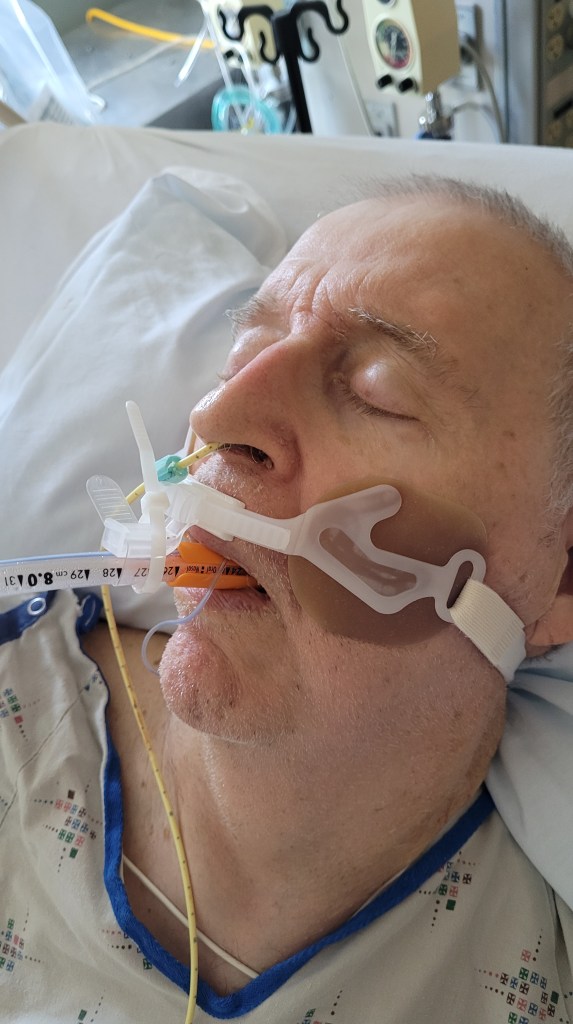
Having heard many scary stories of what general anesthesia could do to the mental status of Lew Body Dementia patients, I was worried. But at least the surgeon listened well to my concerns, so we went ahead and had the surgery. It took longer than planned. The surgeon did say there was a bit of trouble but the surgery was successful. Dennis’s face was now free of the tube in his mouth and all the trappings to hold it there. Red abrasions on his cheeks and a very dry mouth would have a chance to resolve and heal.
However, the wound in his neck and the tracheostomy tube were pretty brutal looking too.
Multiple days with this contraption can make a lot of sorenessTube is gone. Esther asked him for a smile.
One of Dennis’s main problems was that the stroke damaged his swallowing muscles. Secretions like saliva were not being swallowed down his esophagus like he thought. They were going into his trachea and his lungs and there was danger of pneumonia. He needed frequent suctioning of the trach tube and of his mouth. Fortunately, he had a good, strong cough, and they started him on antibiotics to prevent pneumonia.
They tried several times in the next few days to wean Dennis from the ventilator. Each time it wore him out and he could only tolerate a few hours without the machine. Eventually he was able to use less help – the vent was used more like a CPAP. He would initiate his breaths but the machine would do the work of delivering the air. By day 24 he had been off the vent for 48 hours and was only getting humidified air and a little bit of oxygen.
One of the best things during these days was hearing him talk again. On day 20 in the ICU they plugged the trach tube for short periods of time so he could speak to me. He wanted coffee – big discovery. One of the things about his brain injury is that he doesn’t realize the seriousness of what has happened. He talks about wanting to eat and drink, not realizing that he is being “fed” through a nasogastric tube. I spent much of my time with him feeding him ice chips and then suctioning them back out again after they melted.
Things he has told me:
“If Ryan (son-in-law) was here he could help me stand up.”
“Untie my hand so I can hold a cup.”
“Sweet corn and tomatoes!” (after talking about garden with his brother.)
“My butt hurts.”
“More ice chips.”
“How is _____? (He remembers and asks about everyone.)
Dennis was admitted to the Neuro-trauma ICU of St. Mary’s Hospital in Duluth MN, 90 miles from our home in Hayward. It was past visiting hours but after they got him settled in they let me come in and see him. I watched them do neuro checks on him. He was weak on the left side but there was movement, and his face didn’t seem asymmetric. He was joking with the nurses, telling them all about how it felt. He was still on IV medication to keep his blood pressure in a safe range.
I stayed overnight with a friend and was back the next morning. Not much had changed as they tried various meds to keep his blood pressure low. Another CT scan showed there hadn’t been additional bleeding from the night before. The free blood was kind of migrating around though, like a bruise that changes shape as it ages.
Thursday, still in ICU, Dennis was more lethargic. He would open his eyes if asked but he looked sick. They were having a hard time with his blood pressure and giving him higher doses of IV med, as well as fluids and electrolytes. Friday when I visited, I had a hard time getting Dennis to wake up. He didn’t interact with us. It was like he was sedated. It was explained to me that this was a common progression as inflammation was often peaking on the second and third days.
That night back at home, I got a call from the hospital. Dennis had been having a hard time breathing. And then, as they were suctioning to clear his airway, he actually stopped breathing. They intubated him and put him on a ventilator. I drove that night to my friend’s house again, wanting to be close in case anything more happened. As soon as visiting hours started the next morning I went to get the story. This was day #4 in the ICU. He looked very peaceful now that breathing was not so much work.
I couldn’t begin to imagine what was going on inside his head. He was somewhat more alert, opening his eyes a lot more on days #4 and 5. He could still follow orders to move fingers and toes. The biggest difference now was that he could not talk, being intubated. I could tell there were things he wanted to say but it was getting very frustrating.
As it got closer to our family reunion, August 4 – 8, people were arriving at home. I spent part of several days at home, but was at the hospital for hours every day. There was not much I could do except let the staff know, from experience, what Dennis was like and what I thought he wanted. There were conversations about resuscitation, feeding tubes, and DNR status that were kind of scary, but fortunately I knew Dennis wanted to have every chance to live.
On day #7 my brother Gary and Lyn went with me. It was upsetting to them, and frustrating to Dennis. He was very tired and we didn’t stay very long. Tubes and wires everywhere. Alarms going off. Phones ringing. Confusion of loud voices from the other half of his semi-private room. We were starting to understand the term “ICU delirium”.
Things seem to go on forever the same, until they suddenly don’t.
It was a pleasant summer evening. In an attempt to improve my own perspective, I was out having dinner with a couple friends and my mom, in a noisy environment, when the waitress asked if it was my phone that was ringing. It was.
Dennis had been found on the floor by the helper who came to fix his dinner. She called my brother and together they called an ambulance to get him to the ER. He had signs of a stroke.
I don’t think he was on the floor for long, and he had no fall injuries. In fact, in the telling, he was very proud of how he had let himself down carefully so he wouldn’t get hurt. Did I not get him an emergency alert necklace for just times like this? Yes. It spoke this message to him “Fall detected, press and hold to cancel”. So, he pressed and held and cancelled. He was planning on getting to a chair, getting himself up, and recovering. He didn’t want to fuss with the outside help.
He was taken to the ER in our local hospital. They confirmed a hemorrhagic stroke with a CT scan and immediately called an ambulance to take him to a stroke center 90 miles away. I talked with him before they left. He didn’t have severe symptoms – just some left sided weakness and loss of skin sensation. Maybe his speech was a little difficult to understand, but he mumbled a lot anyway and this wasn’t much different.
I followed the ambulance up and was able to see him safely established in his room, hooked up to all the necessary monitors. His blood pressure which had been 225/135 was being carefully kept below 140/90. Another CT scan that night showed no further bleeding apparent.
Things had changed, suddenly. I always knew stroke was a possibility with his blood pressure spikes, which happened frequently. He had stopped taking his meds because he had a period of relative stability without them. He didn’t like taking pharmaceuticals, and I didn’t argue with him since the meds seemed to make no difference. He was equally unstable with or without them. In hind sight I wonder if we could have prevented this, but that is not to be known.
So, on July 26, 2022 Dennis traded his recliner for a $50,000 bed in a neuro trauma ICU. And this was just the start.
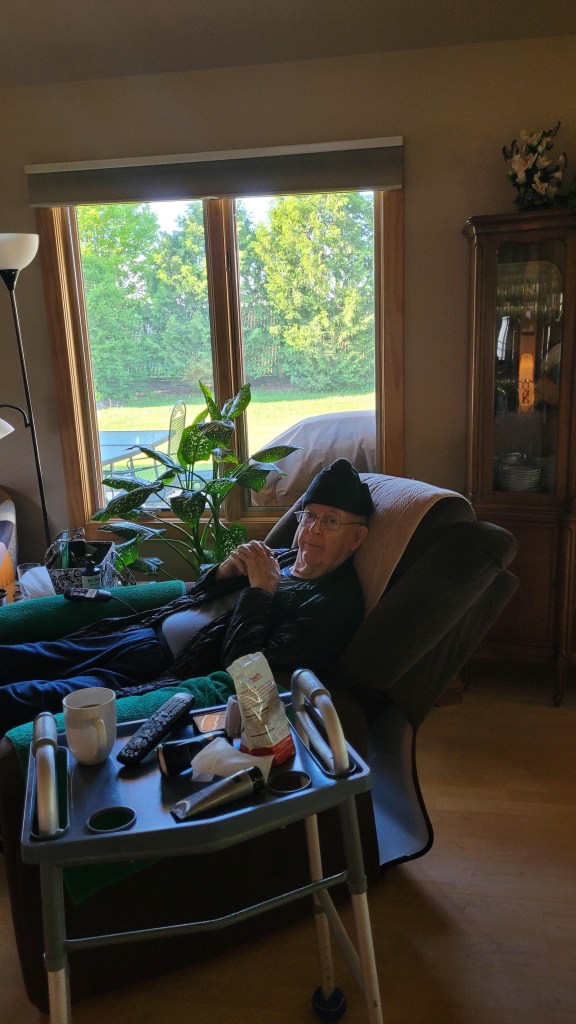
This was not the $50,000 bed but it was a pretty expensive recliner.
It’s Sunday morning and I thought we were going to go to church. After getting up very early, Dennis went back to bed and is sleeping again. I went in to wake him so I could help him get cleaned up, but he is sleeping so soundly that I have let him be.
He sleeps a lot lately. When he is done sleeping in bed, he sleeps in his chair. He sleeps fairly often when I am reading to him. He always listens with his eyes closed and looks like he’s sleeping, but when he breathes heavily or snores, then I know he actually is. I wonder if this is a good thing, or not?
I know it’s very hard not to sleep when inactivity is the norm. He is so physically limited these days that he is weak and unstable when he isn’t sitting or lying down. I asked him last night what factors were foremost in his slowness and sedentariness, and he couldn’t really say and gave up trying. “I don’t know how to explain it. Oh well,…” and the conversation was finished.
He passes on opportunities to go out more often. It complicates any trip to wonder if he will find a convenient restroom when it’s needed, and when he has a hard time managing by himself. Everything is harder when he has to hold on to a walker, when he has trouble pulling up his pants, when he can’t get the walker out the door.
Able bodied people don’t know how good they have it. No they don’t.
I recently read an article attempting to “stage” or give the phases of Lewy Body dementia according to symptoms exhibited. It did not help me at all. He had symptoms in all phases except the last one before death. The only thing I appreciated about it was seeing the list of symptoms he doesn’t have. I have no doubt that we are being spared the worst of it. Almost 4 years into our journey and he still understands who he is, who his family is and how to be reasonably himself.
Although things could surprise us and bring one or the other of us to a final end, in a moment, it is looking like a long road to me. I need a plan for getting help and that is what I’m working on now.
He has three places in the house where he can be found – in bed, at the table and in his lift recliner. It is June but his stocking hat is what keeps him comfortable at night.






 Hope in the Face of Dementia