Dennis, the husband, died early this morning. The bad thing, the difficult, uncomfortable, discouraging, sad thing is over and the good that was promised him is beginning. That’s the story that both of us have believed and we’re very happy to stick with it. A new beginning for him, made possible by Jesus Christ.
I love it that God did not want for any of his creation to be wasted. I love that he always planned a way for the imperfect to become perfect, and that the way had to be through relationship. It’s a precious thing to feel known, valued, and loved even when I haven’t earned it. Even more important, nothing on earth can take away or change what God has in mind for me. I love having the worldview of the one who made the world.
It’s a new beginning for me as well. I am a widow. A single. I’ve had 50 years of being otherwise, and I’m grateful for those years, and for being able to spend them with Dennis. There’s a lot to process here and I might not get around to doing that online. This post is a thank you to all who have followed our journey with Lewy Body Dementia. We learned a lot along the way. I will always have compassion for others who are experiencing this disease in any manner. Caregivers, feel free to reach out for support. I am on your side!
There has come a time when we feel we have done all we needed to do, all we could do. There is only the hard waiting left. That’s how it is now.
Dennis has shown more signs of discomfort and some frustration, even when he can’t explain to us what he is feeling. Sleeping all day, and then sleeping all night, or trying to. Never being sure of what he’s seeing because nothing looks familiar. Not being sure whether his eyes are open or shut because either way things look crazy. No matter how carefully people move his body, he’s left feeling “like a piece of meat”. Being concerned about the meeting he was supposed to have with a client, and then being told that he is retired and doesn’t have to worry about work at all.
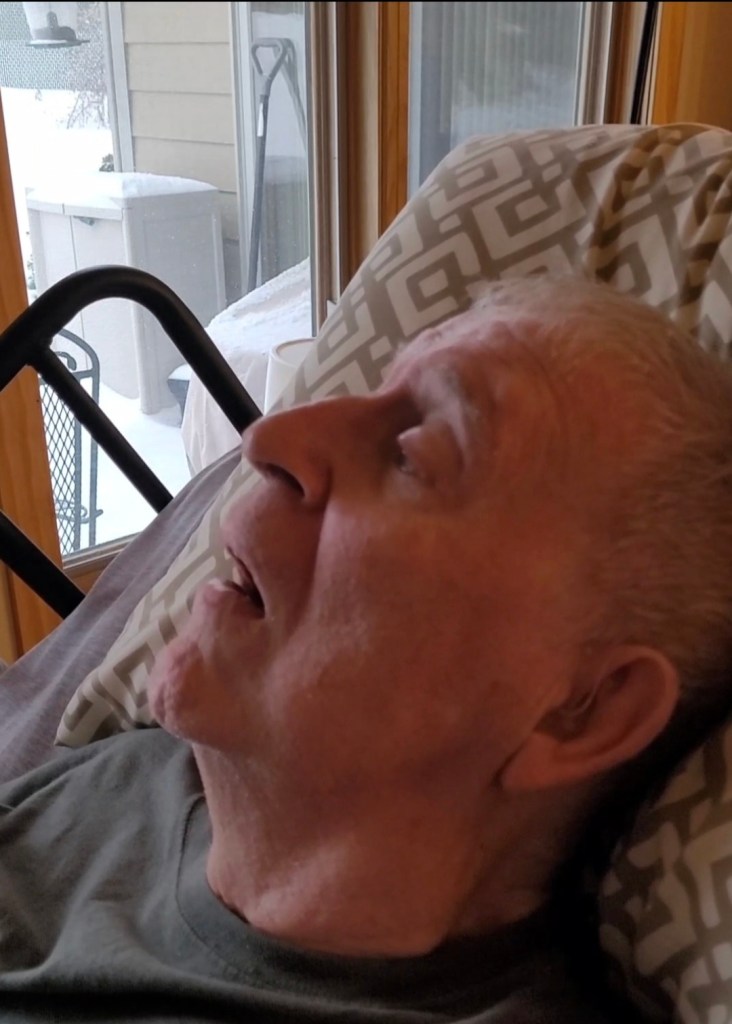
I can tell he is feeling puzzled when he gets that small wrinkle between his eyes and he stares at the ceiling, trying to figure things out. When asked how he’s doing, he most often answers that he is okay. Now, he has managed to tell me a few times that he is not doing so well.
He listens more than talks.
He stays alert for 10 minutes (max) and then has to sleep.
He still thinks about food, but says he is not really hungry.
His reflexes are diminishing, the usual rigidity is softening.
I don’t think he will be here much longer. I will miss him, but I will not miss his suffering. I don’t think he will miss it either.
This was written a couple weeks ago, so it’s more accurate to title it “Where We Were”, but I’m not changing it.
It’s spring. Dennis and I are sitting in the living room. I am trying to feed him sips of coffee. He coughs and chokes each time he swallows. He wants to know where Shirley is, his wife. I’m not sure I’ve convinced him that I’m here. In a voice so soft I can barely catch every other word, he says he has had something he wanted to tell Shirley but she wasn’t here. Where did she go?
He says that he got a call from someone telling him that everyone should read the book he’s written. It’s a book about blood pressure. He wants to know if my mom has read it. While he talks he is always staring up at the ceiling as if he’s connecting with something up there, or in another world.
Yesterday’s conversation was my attempt to talk with him about death. I asked him if he was afraid to die. There are many questions I ask him that he takes the liberty of not answering – this was one of them. I explained that I was asking because I wanted to remind him there was nothing to fear. Death would be a good change because of what we believed about Jesus’s promises. I told him God would probably be in favor of him playing the trumpet again, give him back his ombissure. He would likely be able to walk again, swallow and eat again, and maybe even be with “his dog, Blackie”. He would be able to ask all the questions he ever wanted answered. I could tell it sounded good to him and he repeated some of it with as much excitement as I’ve seen from him lately. Then he went to sleep for the rest of the morning.
And he is sleeping again now. It is his default state, to be off in another world where none of these weird things are happening. He rouses only to inquire about new voices he hears in the room – some of them are real, some are in his head only.
I have been reading a book about another man who had Lewy Body Dementia, written by his wife caregiver. There are so many similarities. That man did not know he had that diagnosis until after he had a stroke. Like Dennis, his disease progressed much faster after the stroke. His time at one hospital after another and finally ending up in a nursing home sounded very familiar to me. I remember pushing Dennis around the halls at Maple Ridge, seeing all the elderly lined up in their chairs around the nursing station with vacant expressions on their faces. It was depressing to him then and he didn’t want to look at them, or to be them. The man in the book felt that same way. I am glad Dennis is not in a nursing home now, although I’m sure they try to be as kind as possible. I feel that I’ve been able to protect some of his dignity.
Conversations with the husband are rare these days. He often talks at length, unaware that his speech is unintelligible. Most of the time his control of speech muscles is minimal, but there are those exceptional times of clarity. It is then that I get a glimpse of what his mental status is.
Today I went over to him because he seemed to be restless, and I thought a little re-orientation would be helpful to calm him. We talked about his memory and who he remembered. I asked him if he knew who I was. He did.
“You’re my wife.”
“Well, I have two rings on my finger. One of them is yours.”
“How many rings have you got on?”
“I have two rings on my finger. You see this?” (holding up my hand)
“Yeah, I see that as four fingers.”
“Yep, and see the rings on that finger?”
“Yeah.”
“One of them is my wedding ring and the other one is yours. One of them is the diamond that you got for me, and the other is your wedding ring that they took off you at the hospital. They were afraid your hands would swell up and it would be too tight.”
“And what ring of mine are you wearing?”
“Your wedding ring.”
“Oh yeah. (pause) Are you married to me now?”
“Yeah, don’t you remember we got married?”
“No.”
“Well, how did I get to be your wife if we didn’t get married?”
(thinking hard) “Yeah.”
That was only one of the interesting exchanges today. Earlier he told me that another me came in the room from his left and joined into the me standing at the bedside, and I was transformed into someone even more me. I’m wondering if this isn’t the beginning of Capgras syndrome, which I’ve heard so much about with Lewy Body dementia. If only the other me’s were able to help out a little more, maybe I could get some rest. Wishful thinking…
Staring out the window at the snowstorm after our conversation.
Puzzles, studying Spanish, writing, trying to stay awake…
I spend a fair amount of time wondering how long this disease is going to hold my husband captive. He seems now to have entered that world of vacant-eyed, non-communicating persons that can’t answer questions anymore. “Do you hurt anywhere?” is too complex a question for him. He has the rhythm of speech, and a searching look as he makes sounds. Every once in a while a real word escapes. It always surprises me that it has nothing to do with a relevant topic. Off the wall, almost off the planet…
I do the things for him that I know I should, not knowing if they are the things he wants done. Does he want to be left alone? Does he want to be bothered and stimulated? Is he listening to us as we talk around him during his care? How does he feel about our routine? So many questions.
As I look at him and think about all the different stages of life we have been through together, I feel so sad. He would never have imagined this helpless, brain damaged state for himself. Who would?
It has been a roller coaster progression. Those days when he is more alert, showing that tiny bit of himself that is recognizable – those days are fewer now. This week he produced the smallest hint of a smile when asked. I hugged him one night and he put his hand on my back and patted it. It was so sweetly familiar it made me cry.
All these thoughts and more swirl around our daily activities, our routines. It is probably a blessing that we have things to do, the husband and I. Useful work anchors our souls in the present, instead of wondering about the future.
Here is our present routine, in case you are curious. The days starts for me around 4:00 am. On a good night, he has slept for hours in the same position and needs to be turned and put in dry briefs. He has also been without a feeding for long enough that he acts restless, which I interpret as hunger. A feeding of formula in his tube quiets his stomach and puts him to sleep again like a sedative.
I take the audio monitor and go over to Mom’s condo for coffee and conversation. I come back in time to crush and give the morning meds, again through the feeding tube. Our caregivers arrive around 8:30 and I like to have my own breakfast done by then. For two hours I can either work with them on some of his more complicated cares, or I can leave to do errands, or maybe even spend time outside on warmer days. They leave by 10:30 and Dennis is up in the recliner for the next five or six hours. The change in position does him good, although he sometimes thinks he is still in bed.
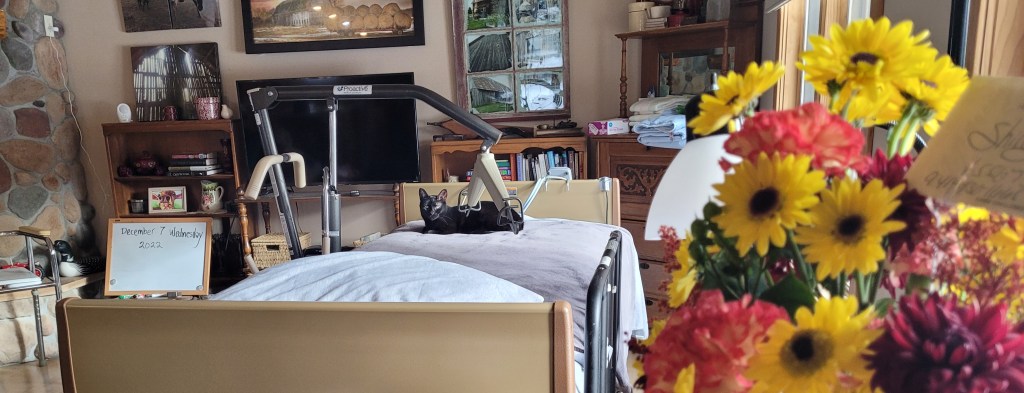
The living room is given over to hospital decor and I’m pretty happy with the way it works.
During his “up” time, I find videos or tv programs for him to listen to. He seldom opens his eyes to watch things but he is often listening. He sleeps a good deal of the time. He gets another feeding around 11. Workers from Hospice do their weekly checking during this time. His RN comes on Tuesdays, the CNA on Thursday mornings. The chaplain has checked in with us, and a volunteer comes once a week to give me free time for a couple hours. I busy myself with daily laundry, ordering supplies, basic housekeeping, and caring for his physical needs until around 3 in the afternoon, when I help him back to bed. I move him with a Hoyer lift, which makes it pretty easy, but it does require some experience. Thankfully, I have years of that with a former client.
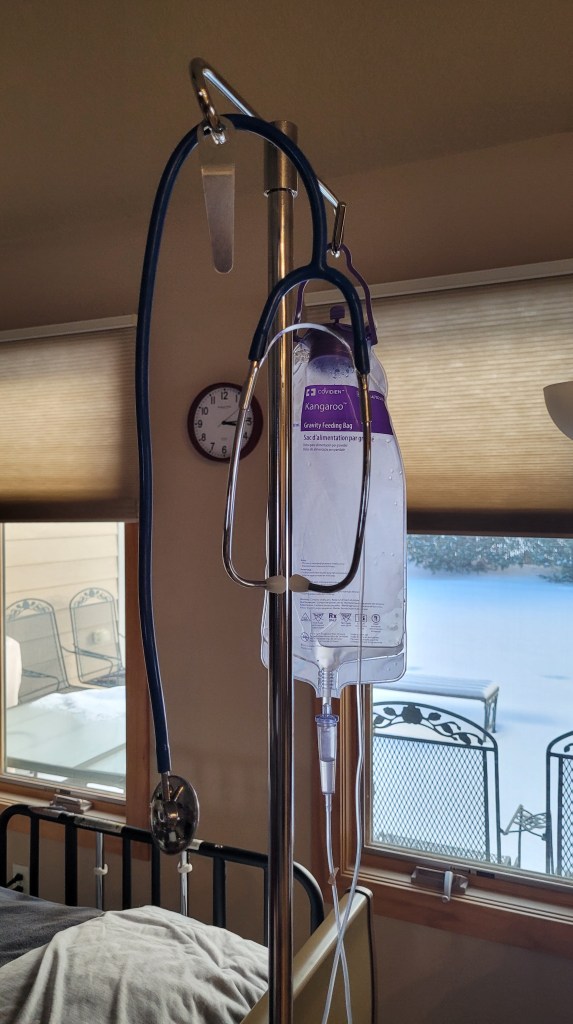
His third feeding of the day, comes at about 4 pm. Feedings are a mixture of 200 milliliters water and 300 ml. formula, given by gravity feed. It gets put in a bag and hung from a pole like an IV. Getting the formula has been a problem and I get messages that it is out of stock all the time. Several times I’ve been down to the last bottle before another shipment comes. That it always does come in time has been one of the ways that I’ve been assured God is aware and caring for us.
Another slew of crushed pills comes at 5 pm. The evening caregiver arrives at 6 to give me another break for dinner. They help get Dennis comfortable for the night before they leave at 8. He gets his last feeding of the day at 9 or 10, depending on how tired I am and how badly I need to sleep. I do go to my bedroom to sleep, but I have the monitor and can hear how he is breathing. I get up and check him at least once, more if he’s having issues.
I record all these happenings, as well as doing blood pressure checks, and giving frequent oral care. I would probably consider it a pretty easy nursing job if it were not 24/7, and if it were not my own dear husband. I have to shut some of the sadness out, or it would be too much.
Changes will come, but for now, this is my caregiver’s world. Many thanks to all who have prayed for us, sent encouragement in one way or another, and been kind in their responses. You are valued and necessary in this journey.
The last four months have taken their toll on Dennis. I have been convinced that he would never get through another hospitalization ordeal like this has been. However, having that thought did not prepare me for the feeling of signing a paper agreeing to not have resuscitation, the DNR document. It came with a lot of emotional weight.
The last time Dennis was able to talk about the subject of hospice he was agreeable to entering the program if it would help him get home from Maple Ridge. He also thought a long while when the hospice nurse asked him if he felt he was capable of making complex decisions about his health. He finally said no, he didn’t feel capable. Being too tired to think very long, and sometimes confused and disoriented, he was still realistic enough (and brave enough) to say that he trusted me to decide for him. Since then he’s become more confused about his own condition, often forgetting that he’s had a stroke. Often he forgets that he hasn’t been getting up and walking to the bathroom. He forgets he hasn’t been eating for months and has a feeding tube.
More often now he is living in his dreams, sometimes with eyes wide open, hallucinating. His hands shoot up while he’s lying in bed and he’s reaching for… who knows what? But each day there are a few good moments when he is oriented and involved with his real surroundings.
Today, sitting up in the recliner, he was watching our YouTube cooking show from Azerbaijan. It’s slow moving with country scenes, animals on the farm, and a very proficient farm couple harvesting food and cooking some amazing dishes. No talking, no fast moving ADHD programming. He perked up and watched and recognized things. He wanted some coffee – the only thing he asks for that I can give him, besides tea. We sat together enjoying the show with me giving him spoonfuls of coffee every now and then, until I noticed he was asleep.
Have you ever really looked at your spouse’s teeth? Not just the ones in front but all of them? I thought I had, kind of, but now that I’m helping brush them, I don’t know what’s in there. In fact, his whole face looks so different now. The musculature is changing, being held differently. It’s painful to watch him change, but here we are. Changing, ever changing.
“I love this new bed by the window with an air mattress! And thanks for putting a man in it at night to keep me warm.” Shadow the cat.
We are nearing the end of our first week with Dennis being at home. A routine is developing. Our helpers are arriving on the assigned days. Every day we figure out some small thing that is a better way of doing, a better product, a better schedule, a better order. Hard things become more do-able.
I am so grateful for all of this. There is a certain comfort having the two of us in the house, three counting Shadow (the cat). Our times are quiet. The sun comes in through our living room windows on a clear day. The moon and stars, reflecting off the snow, light up the still nights. We help Dennis up to sit in the recliner where he sleeps, or listens to TV or music. The cat settles down on his lap in the chair, or on the bed. There is some little chore every hour or so, a medicine, feeding or position change.
The more active parts of the day are getting going in the morning and getting to bed in the evening. There is about an hour of work involved making sure the husband is clean, dry and comfortable. It’s physically taxing for us caregivers and for him. He gets exhausted being lifted, rolled, and “fixed” for whatever is next.
He says very little and sleeps, or has his eyes closed most of the time. He says he has no pain, no fear, very little discomfort ever. He can answer simple questions like that, but ask him anything complicated and he cannot find an answer. He has nothing to say about any of his care, with the exception of answering when I say I am about to take his blood pressure. “Be sure to give it back when you’re done.”
There is evidence that he is not a blank slate. He dreams a lot and talks in his sleep. He asked yesterday if I would read something he wrote “in the spirit”. He was very proud of it and said it was a lot like what the founding fathers would have written, Ben Franklin in particular. He said it was kind of about politics and the need to be a good listener, that silence isn’t necessarily weakness. It took a while for me to get all this from him by asking questions. I wanted to know how I was to read it if it was “in the spirit” and the conversation got too complex at that point. He stopped and admitted it was confusing, to him as well as to me.
I am glad that he does not seem to be suffering or unhappy – those are complicated thoughts, and he just doesn’t have them. I think it is God’s blessing on him that he doesn’t have the awareness of his own condition. He is not a complainer now, although that used to be one of the family’s sore spots. In the past he was more prone to notice one thing not to his liking and disregard a host of commendables. His nature has softened, become more reflective, accepting and content. He has been very open to God moving him in that direction. It is one of the blessings that has come.
One thing yet to be figured out is how I will find my own life around the demands of caregiving. At this point I spend a lot of time staring into space and trying to be ready for the next task. Trying not to run out of supplies, trying to remember medication schedules, trying to be creative in making our time together interesting, good. But it is winter, and there are very few expectations of me. My stress is limited to caregiving. That also is a blessing and I am grateful.
Home is a good place to be when it’s winter outside.
Because no damage was done, I will start with this event which I found somewhat humorous. Before I got to Maple Ridge yesterday, I received a call which started “I need to tell you what happened yesterday afternoon.” That’s not usually going to be a good report.
As it happened someone had left the control for the lift recliner where Dennis could find it. He often feels that making the chair go up and down relieves the burning sensation on his backside. This time it did more than that, as he lifted himself up and slid out of the chair. They had to pick him up off the floor with the lift. There were no bruises or pains as a result, and he looked fine to me when I arrived. I was grateful nothing had ruined our departure which took place a couple hours later.
They called all the staff, over the loudspeaker, to come say goodbye. Evidently that is a common ritual for this kind of facility.
A very resourceful friend found a tilt-in-space wheelchair for us – for free, no less. This made it possible to go home in a wheelchair van which was much less expensive than a stretcher by ambulance. The thirty minute trip was uneventful. I’m going to say that the driver left the minute we went through the front door at home because he didn’t even want to get asked to help. Not that I would have asked him.
The husband trying out his “new to him” wheelchair, which you can’t really see because he does fill it up perhaps a little too well.
The reality of being alone with my helpless husband had a hint of panic associated with it, I admit. But I hooked him up to the rented Hoyer lift and promptly found that it did not lift him high enough to easily leave the wheelchair. Another discovery was that he was not going in the recliner where I had envisioned him spending half of each day. It was too wide for the legs of the Hoyer.
It wasn’t a situation quite as bad as someone having to lift a car off a trapped passenger, but I was surprised that I was able to get him on the side of the bed, unhook the Hoyer, and finally get him straight and lying down. Surprised and tired. It was interesting how he was silent, bent nearly double in the sling, during the whole event. I think God has blessed him with limited awareness of any of the situations he’s in.
He and the cat “re-bonded” immediately, which was very nice to see. He also requested coffee with cream as soon as I had raised the head of the bed.
The rest of the evening was spent putting things away, trying to remember where I had put the things already put away, figuring out the medication and feeding schedule, and meeting a new caregiver who came at 6 pm for a couple of hours. More about that another time.
Since I had never spent a night with him since his “healthcare incarceration”, I did feel the need to sleep close by so I could see how he behaved. That is to say that I did not sleep much but spent most of the night listening to various levels of gurgling and snoring. I think I have learned that he remains quite still and does well when the head of the bed is raised. I believe he had a good night’s rest, but I decided not to ask him just in case. It was enough that he remained alive after his first night at home. We did it.
It’s the first day of December, and in honor of the new month I want to move forward and record our next adventure. The last four months since the husband’s stroke, have been full of hospitals, rehab, and nursing home for him. For me, it’s been hours in the car traveling to keep an eye on his condition, his progress, his caregivers. I’ve spent very little time at home and didn’t feel like doing much when I was there.
So, that’s all changing tomorrow. I can’t believe tomorrow is nearly here, at last. We will be packing up and leaving the nursing home at 2 pm to travel the half hour to our home at Par Place. Some of our transfers took two hours from start to finish but for some reason this one has taken ten days. I have been pushing and being the “squeaky wheel” the whole time – ever since I became convinced that Dennis would be better off, and happier, at home. There have been obstacles in our path, and one after the other, they have melted away.
The new life, well, I debated whether to call it new or more specifically, different. The different life for me will be staying at home and being a full-time caregiver. Hopefully it will give Dennis some consistency and more attention.
However, there is the question of whether or not we can actually do this as well as we would like. I’ve put a lot of thought and effort into getting equipment, supplies, formula for his tube feedings, and helpers. Most weekdays I will have help for two hours in the morning and two hours in the evening. I have friends who will come and give me breaks for exercise, and appointments around town. B
ut he is quite helpless, weak, and often disoriented. All his meds and nourishment have to go through the stomach tube (PEG tube). He is bowel and bladder incontinent. He will have to be moved with a Hoyer lift from his bed to his recliner or wheelchair. He sleeps most of the time. Fortunately, he is still himself on those occasions when he wakes up and talks. He knows me and his friends. He remembers that he is coming home on Friday.
So, because this may be the last thing he and I do together, I want to remember how it went, what we said to each other, and how it felt to know that life might very well be coming to a close. We have talked some about these things, but only recently has he at last confessed that he couldn’t think well enough to be in charge of his own health care. “I trust my wife”, he told the Hospice nurse.
Although we had the conversation, and an evaluation, we won’t be getting help from Hospice. They won’t accept him as long as he has a feeding tube, sorry but those are the rules. I was upset for about five minutes and then remembered that God had been asked to lead and direct, and he is faithful. I was then relieved that Dennis wouldn’t have to be affected by their rules. One less decision that I would have to make.
Every day in December, to write and remember, that is my goal. So, more tomorrow. I’m sure it will be an exciting day…
I can’t bear to show you a picture of Dennis. You get a pretty sunrise instead.
We have not been here before. The husband’s experience with Lewy Body Dementia has been atypical – no hallucinations, personality change, severe memory lapses, or all the other nightmarish things I read about in online support groups. But this stroke and subsequent hospitalizations have taken him down.
It was reasonable to think that he might recover some or all of his pre-stroke abilities, like other stroke victims do. And he did. He got back to breathing unassisted, verbal communication and basic movement and strength in his arms and legs. He was motivated to work hard and was able to express that. He talked to friends on the phone, gave feedback, joked with caregivers, noticed his surroundings.
Even a week ago, he responded to the move to Maple Ridge pretty well. Then came the day I wrote about last, when his lethargy increased and he went nearly comatose. This was the first time a urinary tract infection had affected him like this, something I have read about countless times in the support groups. The day after his two trips to the ER, being started on antibiotics and given a new feeding tube, he was understandably tired, but seemed to rally a bit. He was cooperating with the therapists. We played catch with the beach ball.
Yesterday and today he is once again silent and not communicating. I have to work to stimulate him enough for his eyes to slowly open and stare at me. A wet washcloth, touching his face, turning up the hearing aids, sitting him up in the bed, deliberate and focused speech – all this gets very little response. He is stiff, rigid and difficult to position in bed. There is the perpetual lean to the left that he’s not able to correct as well as he did a week ago.
What happened? Am I seeing the dreaded progression of the dementia? Are we on the Lewy roller coaster? Or is the inconsistency of his care at the facility having something to do with his condition? Will he go in and out of this behavior or is it permanent? So many questions, so few answers.
I’m talking and thinking the language of this answer-less world all day. I recount the day’s happenings to friends, my mom, my daughters, my brother, my pastor, even the nursing home employees who will listen. I’m telling God what it’s like to sit and look at this shell of the man he gave me. I’m constantly going back in my thoughts to this situation we are in.
If he has declined because of the inconsistency of his care, then I need to bring him home. I can be consistent if nothing else. If he has declined because of the progression of his diagnosis, then I need to bring him home, because these may be his last days. Either way, the comfort of being home and of having someone respond to his needs will be the best thing for him. He deserves more than what he is getting now. I think I am ready to bring him home.





 Hope in the Face of Dementia