Hi. I guess if you’re reading here, it’s because dementia is touching your life in some way. I want to share something with you that has recently been very freeing for me.
Be decisive. The ability to make a decision is a power that you still have. The feelings that you have about being helpless and hopeless – those feelings are lies. Take your power in hand and make a decision today. It can be as simple as deciding to rest, deciding to do something you enjoy, deciding to smile at someone when you don’t feel like it.
Decide to be in the moment and look around the space you are in right now. Focus on something in that space that brings you happiness. Let gratitude for that thing/person overwhelm you and be your reward. And, by the way, being grateful is good for you. It can heal.
Let me know about your decision. I am praying for you.
Dennis, the husband, died early this morning. The bad thing, the difficult, uncomfortable, discouraging, sad thing is over and the good that was promised him is beginning. That’s the story that both of us have believed and we’re very happy to stick with it. A new beginning for him, made possible by Jesus Christ.
I love it that God did not want for any of his creation to be wasted. I love that he always planned a way for the imperfect to become perfect, and that the way had to be through relationship. It’s a precious thing to feel known, valued, and loved even when I haven’t earned it. Even more important, nothing on earth can take away or change what God has in mind for me. I love having the worldview of the one who made the world.
It’s a new beginning for me as well. I am a widow. A single. I’ve had 50 years of being otherwise, and I’m grateful for those years, and for being able to spend them with Dennis. There’s a lot to process here and I might not get around to doing that online. This post is a thank you to all who have followed our journey with Lewy Body Dementia. We learned a lot along the way. I will always have compassion for others who are experiencing this disease in any manner. Caregivers, feel free to reach out for support. I am on your side!
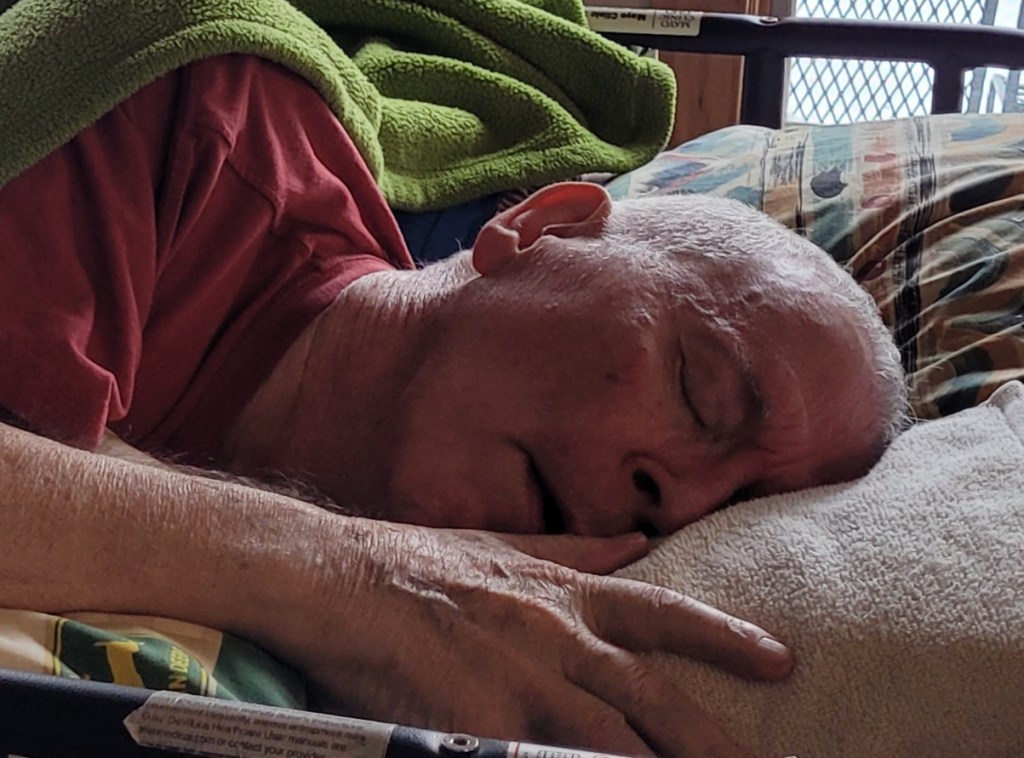
That is the question most often in my mind as I watch the husband. He lies in his bed looking peaceful, but his breathing takes off at times and his eyes open wide. I wonder if he is actually seeing something other than the ceiling when his eyes are open.
He doesn’t seem to be in pain. I wonder, if death doesn’t come with pain, what does it come with? How does it feel to the person dying? Sometimes he makes sounds that could indicate pain and that sound like pain signals to me, but then they cease without any treatment. I remember the vivid dreams he often had that would make him shout and cry out (and punch and kick!) Is that what’s happening as his mind lets go. Does he have real memories? Do his dreams mirror reality or are they even more frightening?
My intuition tells me the end is very close. Close enough so that I am hesitant to leave, even for a short while. I want him to feel like there is someone with him as long as he’s here. I know he doesn’t always know who is with him, but he does act more calm when he’s not alone. He knows someone is there.
I have mixed feelings about friends and family who ask if they should come, and that’s actually a good thing. The ones who come because they can, or need to for their own reasons, they are welcome and help me feel supported. The ones who can’t come, no matter what the reason, are also helping. I am glad they are preserving memories of the husband that are far more dignified, heartwarming, and joyful than the memories I am making now. I’m okay not having everyone seeing him go through this.
If I could see his spirit I’m sure this experience would be different. Unfortunately, what I see is his body, the damaged shell his spirit has to reside in. There is nothing pleasant or easy about watching someone die. In my career as a nurse, I’ve seen death fairly often. I suppose that helps me some now – at least I am not surprised. But each death is unique, and I’ve never seen my husband die.
At night, I most often pull the recliner up next to his bed, so I can take his hand when he seems to be agitated. I’ve gotten used to the signs that mean he needs to change position. I sleep with the sound of his breathing in my ears, either loud and wet or so quiet and shallow that I need to look. Breath and life are so closely allied that the physical action of drawing in air takes in a sacredness. I wonder which one will be his last.
I wonder, I wonder, I wonder… I wonder if he is trying to let go, or struggling not to. I wonder if he’s even aware that it is time.
This was written a couple weeks ago, so it’s more accurate to title it “Where We Were”, but I’m not changing it.
It’s spring. Dennis and I are sitting in the living room. I am trying to feed him sips of coffee. He coughs and chokes each time he swallows. He wants to know where Shirley is, his wife. I’m not sure I’ve convinced him that I’m here. In a voice so soft I can barely catch every other word, he says he has had something he wanted to tell Shirley but she wasn’t here. Where did she go?
He says that he got a call from someone telling him that everyone should read the book he’s written. It’s a book about blood pressure. He wants to know if my mom has read it. While he talks he is always staring up at the ceiling as if he’s connecting with something up there, or in another world.
Yesterday’s conversation was my attempt to talk with him about death. I asked him if he was afraid to die. There are many questions I ask him that he takes the liberty of not answering – this was one of them. I explained that I was asking because I wanted to remind him there was nothing to fear. Death would be a good change because of what we believed about Jesus’s promises. I told him God would probably be in favor of him playing the trumpet again, give him back his ombissure. He would likely be able to walk again, swallow and eat again, and maybe even be with “his dog, Blackie”. He would be able to ask all the questions he ever wanted answered. I could tell it sounded good to him and he repeated some of it with as much excitement as I’ve seen from him lately. Then he went to sleep for the rest of the morning.
And he is sleeping again now. It is his default state, to be off in another world where none of these weird things are happening. He rouses only to inquire about new voices he hears in the room – some of them are real, some are in his head only.
I have been reading a book about another man who had Lewy Body Dementia, written by his wife caregiver. There are so many similarities. That man did not know he had that diagnosis until after he had a stroke. Like Dennis, his disease progressed much faster after the stroke. His time at one hospital after another and finally ending up in a nursing home sounded very familiar to me. I remember pushing Dennis around the halls at Maple Ridge, seeing all the elderly lined up in their chairs around the nursing station with vacant expressions on their faces. It was depressing to him then and he didn’t want to look at them, or to be them. The man in the book felt that same way. I am glad Dennis is not in a nursing home now, although I’m sure they try to be as kind as possible. I feel that I’ve been able to protect some of his dignity.
As his imaginary world becomes more entrenched the husband is always asking me where his dog is. He mentions this dog at least once a day, and this morning it wasn’t just a curious inquiry, it was a need.
It was early in the morning and he was being moved and cared for, but it was upsetting to him. The words were quite clear. “I need my dog.” It was repeated with conviction. “Where is he?”
I have gone the route of explaining that we don’t have a dog, but that he has seen a dog in his mind and that’s okay. That doesn’t seem to help lately, so I have begun telling him that the dog is probably outside since it is not in the house. People take their dogs out in the morning – they have to pee. His dog does too. He wants to know if I can see him and I say no. I tell him not to worry because he has told me himself that the dog is very smart.
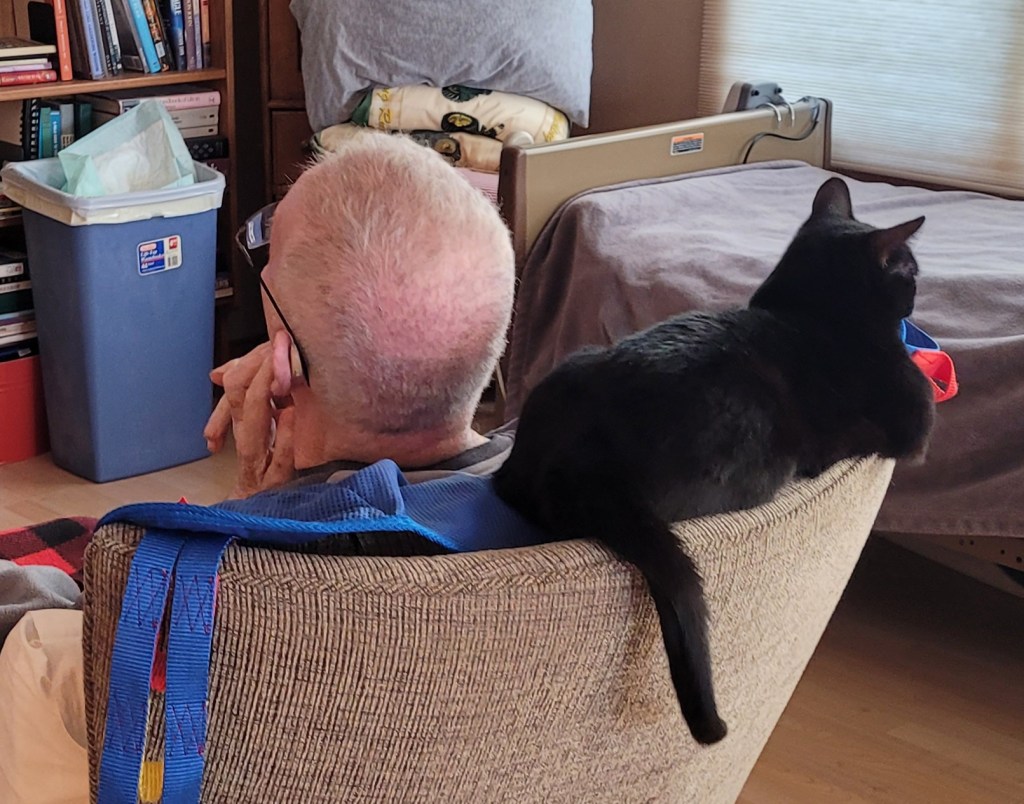
Eventually he will ask for the cat. I can produce a cat. He will hold Shadow on his lap and feel her and this morning he settled down. I am grateful that she does cozy up to him and sit on his lap quite often. She is little and black, like “the dog”.
The cat will have to do.
My theory has the dog being important for several reasons. The husband needs unconditional love at a time when he knows he is unable to give back. It also comforts him to feel responsible for a creature, to still have purpose. Lastly, I don’t know, maybe he always wanted a dog when he was young and never had one. He has always enjoyed some things about the dogs we have had in our years together, but he didn’t have the need that he does now.
His condition continues to decline. I feel there is less engagement overall. There is more confusion, more resignation. One morning last week I asked him if he was okay as I often do when he’s had a coughing spell or seems upset. “Not really.’ he said. He also has started asking me “Am I confused?” These are new admissions for him.
Lest you think that he does a lot of talking, I am recording here most of the significant conversations, and there aren’t many of them. He doesn’t usually talk when we are working with him. His eyes are closed much of the time. He unfailingly produces a smile when asked. Every now and then something will make him laugh. This morning when I told him the dog was outside “taking a leak”, as he calls it, he laughed and said “We’re doing the same thing together.”
Today had a nice start to it. After going for a coffee at Mom’s I returned to Dennis and started our morning routine. I usually ask whether he wants to get up in the recliner, even though I make the choice myself. I think it’s good for him to be more upright for a while, and also gives me a chance to change the bed linens if they need it. Today he said “yes”, and it was because he wanted coffee. Coffee is the only drink he gets, other than mouthwash and water, and it evidently is tied emotionally to normal life in a very important way. He asks for it often, even though it only amounts to five or six spoonful before he is tired.
As we sipped our coffee I told him it was my birthday and invited him to say the greeting to me. He said it clearly and I was thrilled!
“Happy birthday.”
“Oh! You are really talking good this morning!”
A surprised look, as if I would ever think otherwise.
“So, since it’s my birthday, what month is it?”
“April”
“and what date in April is it?”
After a long pause which I thought might not ever end, “Eighth”
Again I was amazed at what he can dredge up out of the usual garbled and confused jumble that his mind has become.
Unfortunately these times are happening less and less. Dennis often has episodes of anxious behavior. Loud, rapid breathing, agitated hand and foot movements, and some loud vocalization’s occur even though his eyes are open and he seems awake. He hands me imaginary somethings and asks me to put them in the box. He joins in a conversation when the other caregiver and I are talking and I assume it’s something relevant to what we’re doing, but no. He wants to know if I’ve cooked salmon, or if I’m ready for the representative from Rhode Island to visit us (what?!). And it’s often the dog that told him to say that – the dog we don’t have but he sees right there in front of us.
A couple of nights I’ve treated this confusion with a sleep medicine, but I have to wonder if he’s more confused after he wakes up. He’s also having signs of pain, which he mostly denies feeling. He calls out loudly and pulls his legs up. Today, after one loud outburst, I asked him if he felt pain and he finally said yes. I asked him where the pain was and he said “my heart”. This is new. I’m not sure how accurate his evaluation is. but it is significant if only because he is usually denying any pain.
I’m getting very tired. Daytime naps are now a must.
I wake up suddenly. It is1:00 a.m., but it’s not very often he actually attempts to call my name and I can’t wait to hear what is happening.
“My pillow.” (said in his soft thick tongued voice which sounds almost like an accent. He never used to sound like this.)
“Oh, your pillow is on the floor! You lost it. Is that better?” (after arranging his head on the pillow again).
“I’m hungry”, he says, as he reaches for my hand.
“Oh no, and I’ve already given you extra before bedtime. I can give you some water though, and maybe a little “food” with it, in the tube.”
I warm up the water and take the leftover formula out of the fridge, load the bag and prime the tube, hook him up and start the drip. He wants to talk more.
“Are you happy?” (Something he’s never asked before).
“No, not really. I’m sad that you’re sick.”
“I’m not sick.”
“It seems like you are, but are you happy?”
“Yes, and I want a cup of coffee. Can you make a cup of coffee?”
“We don’t usually drink coffee in the middle of the night, when we want to sleep.”
“It would make me very happy if you would make me a cup of coffee.”
I can’t believe he’s asking this in such a sweet, almost begging manner. Of course I will make him some coffee. I do the Keurig thing and take it over to him. He has a spoonful.
“You can take a sip” he says.
“I’m going back to bed when we’re done so I’m not going to have more. I took a sip just to make sure it wasn’t too hot for you.”
“I called you here to see if you could make sandwiches for the men.”
This is an odd twist and I’m not sure where it’s going… “what men?”
“The men out on the street. I thought maybe you had sandwiches in the freezer and we could give them some.”
I remind him that he called me to get his pillow, and because he was hungry, but he remembers none of that. After I tell him again about the stroke and how his body doesn’t obey his brain anymore, he tells me I’m exaggerating. I count the months since he’s been unable to walk, or eat or do anything for himself. He stops talking and I ask him why – it’s because I’m arguing with him.
Asleep again.
I can tell the feeding is making him sleepy. He says his stomach feels better. I tell him that it was nice of him to think of hungry men on the street and want to feed them. He had about four tablespoons of coffee during our conversation, so I put the rest away, cover him, and turn out the light.
Conversations with the husband are rare these days. He often talks at length, unaware that his speech is unintelligible. Most of the time his control of speech muscles is minimal, but there are those exceptional times of clarity. It is then that I get a glimpse of what his mental status is.
Today I went over to him because he seemed to be restless, and I thought a little re-orientation would be helpful to calm him. We talked about his memory and who he remembered. I asked him if he knew who I was. He did.
“You’re my wife.”
“Well, I have two rings on my finger. One of them is yours.”
“How many rings have you got on?”
“I have two rings on my finger. You see this?” (holding up my hand)
“Yeah, I see that as four fingers.”
“Yep, and see the rings on that finger?”
“Yeah.”
“One of them is my wedding ring and the other one is yours. One of them is the diamond that you got for me, and the other is your wedding ring that they took off you at the hospital. They were afraid your hands would swell up and it would be too tight.”
“And what ring of mine are you wearing?”
“Your wedding ring.”
“Oh yeah. (pause) Are you married to me now?”
“Yeah, don’t you remember we got married?”
“No.”
“Well, how did I get to be your wife if we didn’t get married?”
(thinking hard) “Yeah.”
That was only one of the interesting exchanges today. Earlier he told me that another me came in the room from his left and joined into the me standing at the bedside, and I was transformed into someone even more me. I’m wondering if this isn’t the beginning of Capgras syndrome, which I’ve heard so much about with Lewy Body dementia. If only the other me’s were able to help out a little more, maybe I could get some rest. Wishful thinking…
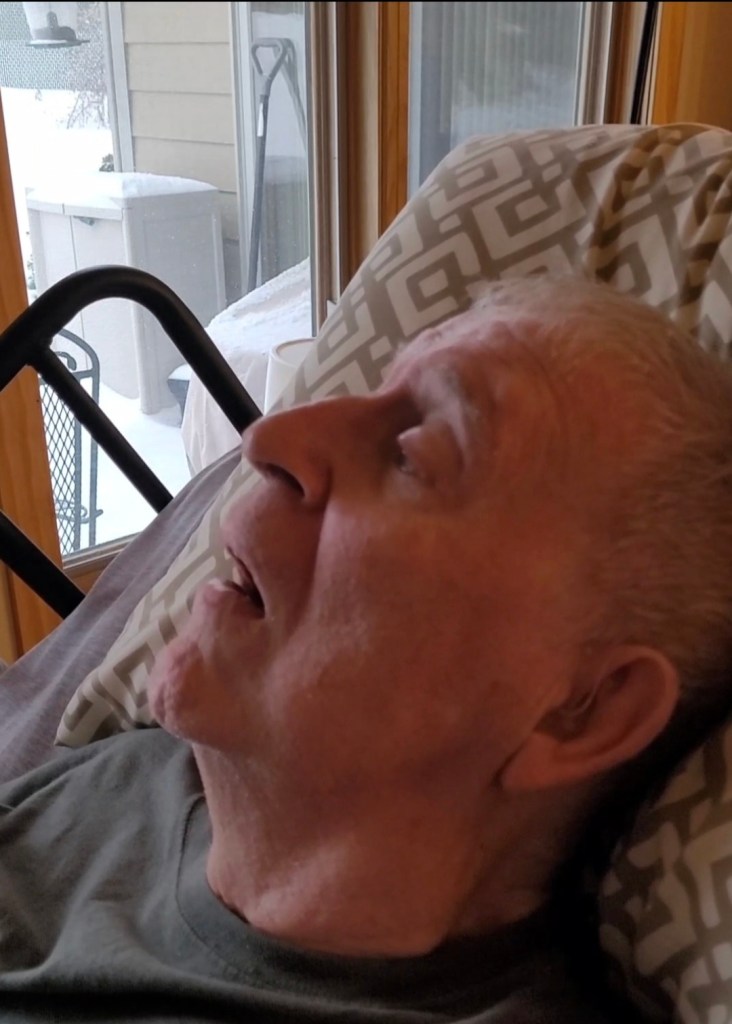
Staring out the window at the snowstorm after our conversation.
Puzzles, studying Spanish, writing, trying to stay awake…
I spend a fair amount of time wondering how long this disease is going to hold my husband captive. He seems now to have entered that world of vacant-eyed, non-communicating persons that can’t answer questions anymore. “Do you hurt anywhere?” is too complex a question for him. He has the rhythm of speech, and a searching look as he makes sounds. Every once in a while a real word escapes. It always surprises me that it has nothing to do with a relevant topic. Off the wall, almost off the planet…
I do the things for him that I know I should, not knowing if they are the things he wants done. Does he want to be left alone? Does he want to be bothered and stimulated? Is he listening to us as we talk around him during his care? How does he feel about our routine? So many questions.
As I look at him and think about all the different stages of life we have been through together, I feel so sad. He would never have imagined this helpless, brain damaged state for himself. Who would?
It has been a roller coaster progression. Those days when he is more alert, showing that tiny bit of himself that is recognizable – those days are fewer now. This week he produced the smallest hint of a smile when asked. I hugged him one night and he put his hand on my back and patted it. It was so sweetly familiar it made me cry.
All these thoughts and more swirl around our daily activities, our routines. It is probably a blessing that we have things to do, the husband and I. Useful work anchors our souls in the present, instead of wondering about the future.
Here is our present routine, in case you are curious. The days starts for me around 4:00 am. On a good night, he has slept for hours in the same position and needs to be turned and put in dry briefs. He has also been without a feeding for long enough that he acts restless, which I interpret as hunger. A feeding of formula in his tube quiets his stomach and puts him to sleep again like a sedative.
I take the audio monitor and go over to Mom’s condo for coffee and conversation. I come back in time to crush and give the morning meds, again through the feeding tube. Our caregivers arrive around 8:30 and I like to have my own breakfast done by then. For two hours I can either work with them on some of his more complicated cares, or I can leave to do errands, or maybe even spend time outside on warmer days. They leave by 10:30 and Dennis is up in the recliner for the next five or six hours. The change in position does him good, although he sometimes thinks he is still in bed.
The living room is given over to hospital decor and I’m pretty happy with the way it works.
During his “up” time, I find videos or tv programs for him to listen to. He seldom opens his eyes to watch things but he is often listening. He sleeps a good deal of the time. He gets another feeding around 11. Workers from Hospice do their weekly checking during this time. His RN comes on Tuesdays, the CNA on Thursday mornings. The chaplain has checked in with us, and a volunteer comes once a week to give me free time for a couple hours. I busy myself with daily laundry, ordering supplies, basic housekeeping, and caring for his physical needs until around 3 in the afternoon, when I help him back to bed. I move him with a Hoyer lift, which makes it pretty easy, but it does require some experience. Thankfully, I have years of that with a former client.
His third feeding of the day, comes at about 4 pm. Feedings are a mixture of 200 milliliters water and 300 ml. formula, given by gravity feed. It gets put in a bag and hung from a pole like an IV. Getting the formula has been a problem and I get messages that it is out of stock all the time. Several times I’ve been down to the last bottle before another shipment comes. That it always does come in time has been one of the ways that I’ve been assured God is aware and caring for us.
Another slew of crushed pills comes at 5 pm. The evening caregiver arrives at 6 to give me another break for dinner. They help get Dennis comfortable for the night before they leave at 8. He gets his last feeding of the day at 9 or 10, depending on how tired I am and how badly I need to sleep. I do go to my bedroom to sleep, but I have the monitor and can hear how he is breathing. I get up and check him at least once, more if he’s having issues.
I record all these happenings, as well as doing blood pressure checks, and giving frequent oral care. I would probably consider it a pretty easy nursing job if it were not 24/7, and if it were not my own dear husband. I have to shut some of the sadness out, or it would be too much.
Changes will come, but for now, this is my caregiver’s world. Many thanks to all who have prayed for us, sent encouragement in one way or another, and been kind in their responses. You are valued and necessary in this journey.
These are some of the most frequent questions I’m asked this winter. The husband has been home since the beginning of December. Each time, the opportunity comes along to orient him I tell him how he’s been sick for six months and in several hospitals and a nursing home, but that he is now at home.
Unedited view of our living room hospital. We are grateful to have a 50+ year old recliner which was Dennis’s mom’s favorite chair. It is the only chair small enough for the hoyer to close in on.
“We are in our condo in Hayward and you are in our living room. You are in a hospital bed because you are too weak to walk. You have a hard time swallowing and are fed through a feeding tube into your stomach.”
It is all news to him. Sometimes these things register and other times he just closes his eyes and says nothing. The next time he has to go to the bathroom, that’s exactly what he thinks he can do – he needs to be reoriented all over again.
I tell him “You can’t get. up. You aren’t strong enough to walk and haven’t walked for months.”
He tells me, “How do we know if you won’t let me?”
I tell him, “If you could walk, you would be up doing it because I’m not stopping you.”
This exchange is about as feisty as he ever gets. He has the same cooperative nature that he has always had, but the cognitive decline is very noticeable.
Lately the neurological decline is more apparent also. There are times when he cannot speak clearly, or at all. Other times he can suddenly have a conversation and be understood. What he’s saying may not make sense, but I can tell what the words are.
There are some nights that I think he’s dying (nights are always the worst times) but the morning comes and things look different. His body is stronger than his brain. If he gets an infection of some kind things could change quickly. I try to be careful in caring for him – in the complexities of enteral feeding, medication administration, watching for skin breakdown and managing incontinence.
It helps to have Hospice on the journey with us. I don’t have to make decisions alone in most cases. It helps to be able to hire help, to share the heavy lifting and the unpleasantness of necessary tasks. God has supplied a wealth of resources in all areas of need and that is good because this might be a long haul.
Some details:
– Dennis is on 3 enteral feedings daily, about 8 hours apart, which amount to a 1200 calorie diet. He does get hungry and that looks like restlessness. When I see that I know it is time for a feeding. A full stomach is very soothing for him and it puts him to sleep for several hours.
– His blood pressure has been stable on the three blood pressure meds that he gets twice a day.
– He’s had a UTI recently and been on 3 different antibiotics. One was finished when we found out the culture indicated two different ones. Lots of bacteria getting killed.
– Most of the day is spent sleeping in his mother’s LazyBoy recliner, with an occasional awake moment in front of the tv. He might be listening to much of what goes on. There is occasional evidence.
– The rest of the time he is in his hospital bed in a variety of positions. He goes back and forth between these two places with the help of Harvey the Hoyer. Dennis decided on the name and it gives us a good laugh.
– Our paid caregivers come weekdays for two hours in the morning to help the husband up into the recliner for the day, and for two hours in the evening to get him prepared for the night. Every other weekend I have help, but we are working on that. I’m still filling in the day and doing the nights. It’s interesting and sometimes exhausting but when I need to, I get sleep.
– We are grateful for the humidifier that runs 24/7 in our dry winter climate
– Our daughters visited recently and were able to connect with their dad in good ways, mostly through songs. He still remembers and comes out of lethargy to sing when coaxed. Thank you Esther for the humidifier and Julie for the seemingly endless supply of cookies to cheer my soul.
That’s all for this update.
Harvey the Hoyer, an awkward but absolutely necessary piece of equipment.




 Hope in the Face of Dementia