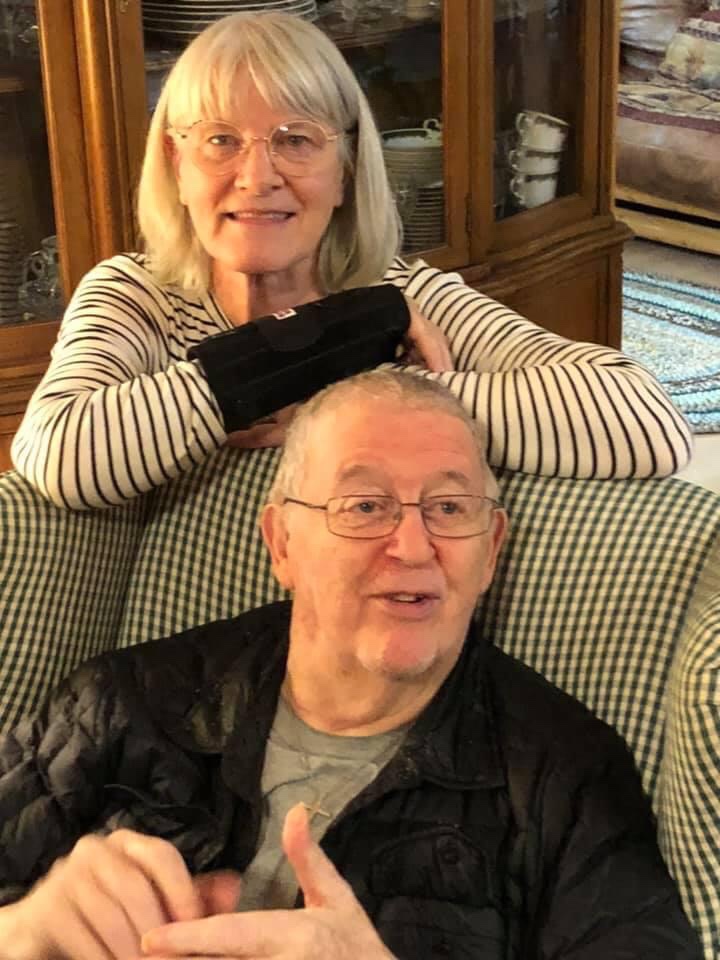
Our Fourth Winter Begins

Fight the darkness

It is a stunning realization – we have begun our fourth winter since the husband’s diagnosis of Lewy Body Dementia, LBD. It is hard to say if the things we have done since September 2018 have been the right things, or have been done consistently or for long enough time. It’s just hard to imagine that one could quickly change the course of a disease that’s been in progress for many years. We may not have stopped it in its tracks, but it is clear that our journey is different from most others, so far.

LBD quickly becomes a story told by the caretaker. I remember attending a conference for LBD patients and their spouses/caretakers at Mayo Clinic in 2019 where a patient was one of the main speakers. He did a good job. I wonder how he is now. I have a feeling he was a rare case.

My Dennis used to think and talk about the book he was going to write telling his experience with LBD, and his reversal of the disease, of course. That doesn’t get mentioned anymore. He doesn’t write anything, and sometimes has trouble signing his name. A book is not the kind of project he would have been motivated to finish even when he was well, so it is not surprising to me that it has never even been started. Talking has always been his mode of communication. LBD has not changed that.

He has cognitive deficits that he is aware of, but his personality is intact. His curiosity and desire to learn is still there. His need to teach and share what he knows is still prevalent. He surprised us all over the Thanksgiving holiday by having some fairly deep conversations with several people, in which he almost seemed normal in a “pre-Lewy” way. He listens every morning when we read. He asks intelligent questions and makes reasonable comments. But prolonged thinking tires him out and he no longer tries to convince, debate or argue his points.

I left this morning to take Mom to an early doctor appointment. Dennis was listening to a favorite podcast and started to tell me something he thought was very important, which I didn’t have time to hear. When I asked him at lunch what the important thing was, he couldn’t remember it. He said he was having more trouble with his memory again. It did finally come to him, but he had to ask me to find the podcast for him on his phone and play it over.

*******************************************************************************

I’ve been gone most of the day, taking mom to appointments and for groceries. He sits in his lift chair, silence in the room – a rare occasion. I ask him what’s on his mind, and does he need socialization, from me. He says “no”. He’s thinking about a sermon he heard earlier on TV. I don’t believe him. I sit down and tell him about my day and read to him.


Being “Right” Comes Full Circle

(It has been suggested by the husband that I write this to his daughters. He has Lewy Body Dementia, and once in a while, it adds to life instead of just taking away.)

We were reading a thoughtful paragraph on humility this morning, referencing people who are always right about anything and everything. Dennis laughed and said something that our youngest daughter had said to him once. “I am right, because I am a Dietz!” It was said tongue in cheek and they laughed at it at the time too. Then he got quiet and continued, “I love our daughters so much. I hope they know that.”

It was a special moment and we continued talking about the meaning of that conversation and why the memory of it sparked such gratitude and love inside his “dad heart”.

During the years our daughters were growing up at home there were so many good times for us as parents and for them as children. There were also times, not so good, when they felt distanced from their parents. The role of provider was always of high concern for Dennis, and required a lot of his attention. Maybe small people (children), having limited experiences, were not as interesting as other friends and business associates. He never intentionally conveyed this to them, but it was conveyed nonetheless.

In addition it was natural to assume that children’s opinions, reasons, and thought processes were still to be directed and molded, not listened to and considered. This attitude also was never intentionally spoken, nor was it applied 100% of the time, but over the years it was felt, sometimes acutely. Although Dad provided well and loved them, he didn’t know them personally and was often clueless as to what they were feeling. Perhaps they heard more of “don’t leave toothpaste in the sink” and “your lights were left on – go turn them off” than the things daughters need to hear from their dads.

So what does it mean when a daughter can tease, laugh and point out some hurtful flaw when talking to her dad? What did it mean that she could remind him of that “always right” attitude in a gentle conversation (well, I don’t actually know how gentle it was or what it was about because I wasn’t there…)? To him, it meant forgiveness. It meant that she wasn’t afraid to remind him of that proclivity of his. It was acknowledgement and grace extended. And it was love.

The husband has mellowed so much in the last few years. Retirement has put the distraction of being a provider behind him. He fully realizes those things he has missed by not being more aware, more curious, more persistent about knowing his children. He has also been diagnosed with a heartbreaking condition. But it has turned into a blessing. It’s almost as if his heart had to be broken in order for him to know what was in it. It’s amazing to think about.

Although he is disabled, he has traveled long distances to see each of his two daughters get married, during pandemic times. He would not have missed these opportunities for the world. “Being right” has come full circle and is now much more like “Being in love.”

It provides hope for us all. We can grow, learn, change. The whole story doesn’t have to be pretty for the outcome to be good. God be praised for his transforming power, his gentleness and his wisdom, and his mysterious ways.

What Hope Can Do

I haven’t recorded all the things that Dennis has gotten through lately, and since they are remarkable they should be recorded.

We’re in a stage where the doctors seem to be done with him. No one is checking him or recommending new treatments. He has discontinued some of the supplements that didn’t seem to have much effect, but were costing a lot of money. It could be viewed as a discouraging time, but he remains outwardly hopeful and unperturbed.

He was a little unsure about the travel we had planned for the second half of July – it was ambitious. We went from our home in Wisconsin to Seattle, by car for “wedding week”. He wanted very much to be present to see this daughter get married so he did what he could to prepare, and tried not to put any trouble in the mix of all we had to do.

We spent five days driving out, in which we learned to get in and out of hotels, restaurants and restrooms with all our “stuff”. It was very different from being at home and I was unsure what that would do to him, but he adapted. There were a lot of times when the challenge of steps, inclines, small spaces, and long hours made him very tired. We had a wheelchair/walker with us but by the end of wedding week and the four day return trip, he was riding in the wheelchair most of the time. I was very worried that he might fall.

It was a good trip. We were relieved and amazed to be back home after two weeks away. He has recovered and not experienced any lasting changes from all the unusual routines. I thank God every time I think back on this time.

Yesterday morning, praying about the day ahead, God and I came to an agreement. Our new son-in-law’s parents were coming for their first visit to our town and I had arranged with a friend for a boat ride on our favorite lake. I knew it would be kind of weird for Dennis not to be there with us, but I questioned whether we could get him in the boat easily. Even he had said he would just stay home because it sounded hard. We had done this same excursion two years ago with different friends and it had been hard then. He has declined a lot since.

Back to the agreement. I felt that I should ask Dennis again if he wanted to go on the boat, and if he did we would plan on it and God would help us. As I suspected, Dennis wanted to go. Here’s how it went down.

We arrived at “Lunch on the Lake” and talked with Mr. Jacobsen. He allowed us to drive down the steep embankment, on their lawn, to get near their boat dock. Dennis used his walker to finish the distance and get out on the long narrow dock. It took a great deal of coaching and encouragement from all five of us to tell him where to hang on, which part of him to move next, how high to lift his feet, when to duck under the boat awning, etc… , and we were ready to catch him at any moment if we had to, but he made it. It was remarkable because this is a guy who often has trouble just getting in bed.

There he is, in the boat.

We had a good hour long boat ride and a nice lunch with our guests before we had to repeat the whole process in reverse. I think we all had a sense of accomplishment when it was over and we were in the car again. We did a little more sightseeing with him riding in the wheelchair, and by the time company left, he was ready for his overdue nap.

But, can you see what hope can do? Sometimes God gives us challenges and wants to see what we will do with them. With the challenge, he promises to help, to teach, to show up in some way to demonstrate remarkable things. I am so thankful we are not on this journey alone.

This guy. Hopeful.

The Elephant

Part of my problem as a writer is that I often feel like a minor player in someone else’s drama. Even if they don’t write their own story, I feel like I’m stealing if I write about it.

In searching for reasons why he was diagnosed with Lewy Body Dementia just weeks after his retirement, the husband has wondered if he is supposed to share his experience with others. Could it be he is meant to encourage others in some way, even though he is pretty sick about this whole thing? He actually says he might start a blog, or write stuff down as he thinks of it. For several reasons, I think the chances of him writing anything are slim.

For one, he has a history of brilliant ideas that never see action. I don’t see his diagnosis changing that.

Reason two – he doesn’t have experience expressing feelings. He has them, but they don’t usually bother him or beg to be shared. He would like to share things now, but they end up coming out in long, convoluted histories of his life journey accompanied by tears, and a tone of desperation and sadness. He’s doing it a little better now, but the first couple of weeks were tough and any compassionate person who had time to listen patiently ended up crying with him and giving him a hug.

Reason three is simply that writing is work and work isn’t something he’s looking for. Too much mental work makes his head spin.

It’s true that my story has a lot to do with his story but, of course, I tell it from a very different perspective. He reads what I write. I wonder if I will be able to write what I really think or will I change the narrative because of the effect it might have on him?

Interestingly, the two things that have helped the husband and I know each other better in the last few years are our “together” prayers and my blog/journal. I guess in each instance I tend to be more open, truthful and informative. In each instance he feels less threatened by my words because they aren’t spoken to him – they are conversations with God or my readers. He listens better. And the same goes for him when it comes to telling God his thoughts and concerns – one might as well be honest. When he prays, I learn things about him that he doesn’t think to tell me.

It certainly isn’t that I don’t want him to write his own story, from his own perspective. I do. But not writing about this part of my own life has been hard. The vague feeling that I couldn’t write about this big thing happening to us, has made me not write much at all. Somehow, when there is “an elephant” in the room, so to speak, writing about anything else takes second place to wondering about the elephant and what it’s going to do next.

That elephant is on my mind most all the time. I might as well write about it. Probably have to. Just sayin’…