Hi. I guess if you’re reading here, it’s because dementia is touching your life in some way. I want to share something with you that has recently been very freeing for me.
Be decisive. The ability to make a decision is a power that you still have. The feelings that you have about being helpless and hopeless – those feelings are lies. Take your power in hand and make a decision today. It can be as simple as deciding to rest, deciding to do something you enjoy, deciding to smile at someone when you don’t feel like it.
Decide to be in the moment and look around the space you are in right now. Focus on something in that space that brings you happiness. Let gratitude for that thing/person overwhelm you and be your reward. And, by the way, being grateful is good for you. It can heal.
Let me know about your decision. I am praying for you.
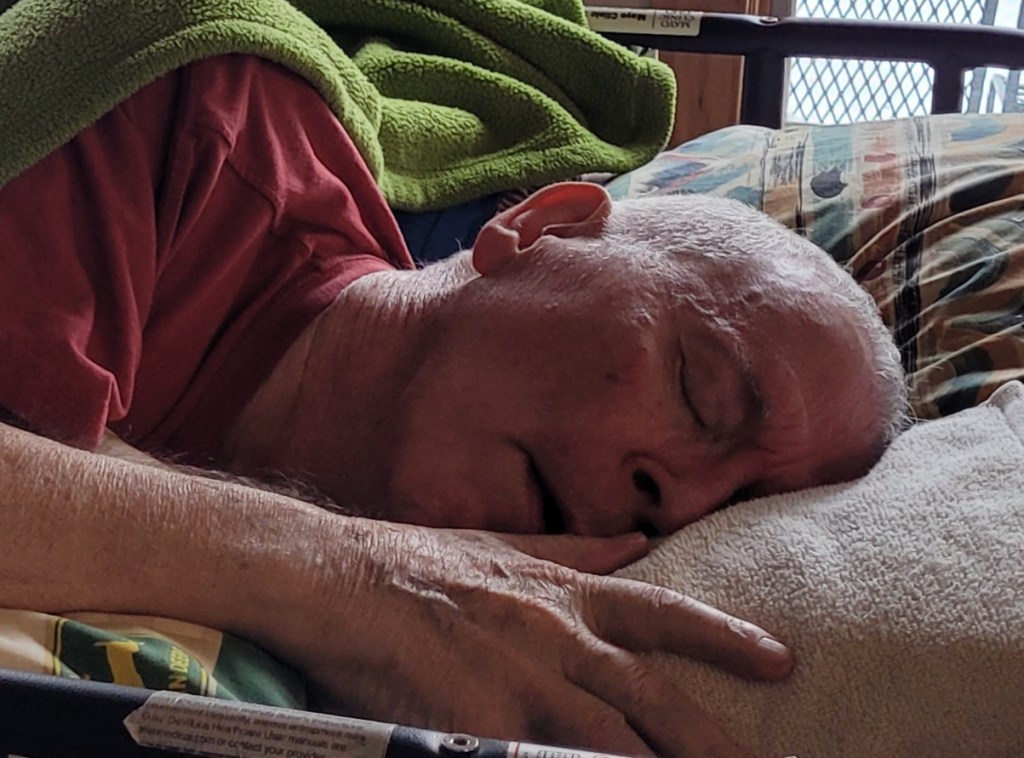
That is the question most often in my mind as I watch the husband. He lies in his bed looking peaceful, but his breathing takes off at times and his eyes open wide. I wonder if he is actually seeing something other than the ceiling when his eyes are open.
He doesn’t seem to be in pain. I wonder, if death doesn’t come with pain, what does it come with? How does it feel to the person dying? Sometimes he makes sounds that could indicate pain and that sound like pain signals to me, but then they cease without any treatment. I remember the vivid dreams he often had that would make him shout and cry out (and punch and kick!) Is that what’s happening as his mind lets go. Does he have real memories? Do his dreams mirror reality or are they even more frightening?
My intuition tells me the end is very close. Close enough so that I am hesitant to leave, even for a short while. I want him to feel like there is someone with him as long as he’s here. I know he doesn’t always know who is with him, but he does act more calm when he’s not alone. He knows someone is there.
I have mixed feelings about friends and family who ask if they should come, and that’s actually a good thing. The ones who come because they can, or need to for their own reasons, they are welcome and help me feel supported. The ones who can’t come, no matter what the reason, are also helping. I am glad they are preserving memories of the husband that are far more dignified, heartwarming, and joyful than the memories I am making now. I’m okay not having everyone seeing him go through this.
If I could see his spirit I’m sure this experience would be different. Unfortunately, what I see is his body, the damaged shell his spirit has to reside in. There is nothing pleasant or easy about watching someone die. In my career as a nurse, I’ve seen death fairly often. I suppose that helps me some now – at least I am not surprised. But each death is unique, and I’ve never seen my husband die.
At night, I most often pull the recliner up next to his bed, so I can take his hand when he seems to be agitated. I’ve gotten used to the signs that mean he needs to change position. I sleep with the sound of his breathing in my ears, either loud and wet or so quiet and shallow that I need to look. Breath and life are so closely allied that the physical action of drawing in air takes in a sacredness. I wonder which one will be his last.
I wonder, I wonder, I wonder… I wonder if he is trying to let go, or struggling not to. I wonder if he’s even aware that it is time.
There has come a time when we feel we have done all we needed to do, all we could do. There is only the hard waiting left. That’s how it is now.
Dennis has shown more signs of discomfort and some frustration, even when he can’t explain to us what he is feeling. Sleeping all day, and then sleeping all night, or trying to. Never being sure of what he’s seeing because nothing looks familiar. Not being sure whether his eyes are open or shut because either way things look crazy. No matter how carefully people move his body, he’s left feeling “like a piece of meat”. Being concerned about the meeting he was supposed to have with a client, and then being told that he is retired and doesn’t have to worry about work at all.
I can tell he is feeling puzzled when he gets that small wrinkle between his eyes and he stares at the ceiling, trying to figure things out. When asked how he’s doing, he most often answers that he is okay. Now, he has managed to tell me a few times that he is not doing so well.
He listens more than talks.
He stays alert for 10 minutes (max) and then has to sleep.
He still thinks about food, but says he is not really hungry.
His reflexes are diminishing, the usual rigidity is softening.
I don’t think he will be here much longer. I will miss him, but I will not miss his suffering. I don’t think he will miss it either.
This was written a couple weeks ago, so it’s more accurate to title it “Where We Were”, but I’m not changing it.
It’s spring. Dennis and I are sitting in the living room. I am trying to feed him sips of coffee. He coughs and chokes each time he swallows. He wants to know where Shirley is, his wife. I’m not sure I’ve convinced him that I’m here. In a voice so soft I can barely catch every other word, he says he has had something he wanted to tell Shirley but she wasn’t here. Where did she go?
He says that he got a call from someone telling him that everyone should read the book he’s written. It’s a book about blood pressure. He wants to know if my mom has read it. While he talks he is always staring up at the ceiling as if he’s connecting with something up there, or in another world.
Yesterday’s conversation was my attempt to talk with him about death. I asked him if he was afraid to die. There are many questions I ask him that he takes the liberty of not answering – this was one of them. I explained that I was asking because I wanted to remind him there was nothing to fear. Death would be a good change because of what we believed about Jesus’s promises. I told him God would probably be in favor of him playing the trumpet again, give him back his ombissure. He would likely be able to walk again, swallow and eat again, and maybe even be with “his dog, Blackie”. He would be able to ask all the questions he ever wanted answered. I could tell it sounded good to him and he repeated some of it with as much excitement as I’ve seen from him lately. Then he went to sleep for the rest of the morning.
And he is sleeping again now. It is his default state, to be off in another world where none of these weird things are happening. He rouses only to inquire about new voices he hears in the room – some of them are real, some are in his head only.
I have been reading a book about another man who had Lewy Body Dementia, written by his wife caregiver. There are so many similarities. That man did not know he had that diagnosis until after he had a stroke. Like Dennis, his disease progressed much faster after the stroke. His time at one hospital after another and finally ending up in a nursing home sounded very familiar to me. I remember pushing Dennis around the halls at Maple Ridge, seeing all the elderly lined up in their chairs around the nursing station with vacant expressions on their faces. It was depressing to him then and he didn’t want to look at them, or to be them. The man in the book felt that same way. I am glad Dennis is not in a nursing home now, although I’m sure they try to be as kind as possible. I feel that I’ve been able to protect some of his dignity.
I wake up suddenly. It is1:00 a.m., but it’s not very often he actually attempts to call my name and I can’t wait to hear what is happening.
“My pillow.” (said in his soft thick tongued voice which sounds almost like an accent. He never used to sound like this.)
“Oh, your pillow is on the floor! You lost it. Is that better?” (after arranging his head on the pillow again).
“I’m hungry”, he says, as he reaches for my hand.
“Oh no, and I’ve already given you extra before bedtime. I can give you some water though, and maybe a little “food” with it, in the tube.”
I warm up the water and take the leftover formula out of the fridge, load the bag and prime the tube, hook him up and start the drip. He wants to talk more.
“Are you happy?” (Something he’s never asked before).
“No, not really. I’m sad that you’re sick.”
“I’m not sick.”
“It seems like you are, but are you happy?”
“Yes, and I want a cup of coffee. Can you make a cup of coffee?”
“We don’t usually drink coffee in the middle of the night, when we want to sleep.”
“It would make me very happy if you would make me a cup of coffee.”
I can’t believe he’s asking this in such a sweet, almost begging manner. Of course I will make him some coffee. I do the Keurig thing and take it over to him. He has a spoonful.
“You can take a sip” he says.
“I’m going back to bed when we’re done so I’m not going to have more. I took a sip just to make sure it wasn’t too hot for you.”
“I called you here to see if you could make sandwiches for the men.”
This is an odd twist and I’m not sure where it’s going… “what men?”
“The men out on the street. I thought maybe you had sandwiches in the freezer and we could give them some.”
I remind him that he called me to get his pillow, and because he was hungry, but he remembers none of that. After I tell him again about the stroke and how his body doesn’t obey his brain anymore, he tells me I’m exaggerating. I count the months since he’s been unable to walk, or eat or do anything for himself. He stops talking and I ask him why – it’s because I’m arguing with him.
Asleep again.
I can tell the feeding is making him sleepy. He says his stomach feels better. I tell him that it was nice of him to think of hungry men on the street and want to feed them. He had about four tablespoons of coffee during our conversation, so I put the rest away, cover him, and turn out the light.
I can’t bear to show you a picture of Dennis. You get a pretty sunrise instead.
We have not been here before. The husband’s experience with Lewy Body Dementia has been atypical – no hallucinations, personality change, severe memory lapses, or all the other nightmarish things I read about in online support groups. But this stroke and subsequent hospitalizations have taken him down.
It was reasonable to think that he might recover some or all of his pre-stroke abilities, like other stroke victims do. And he did. He got back to breathing unassisted, verbal communication and basic movement and strength in his arms and legs. He was motivated to work hard and was able to express that. He talked to friends on the phone, gave feedback, joked with caregivers, noticed his surroundings.
Even a week ago, he responded to the move to Maple Ridge pretty well. Then came the day I wrote about last, when his lethargy increased and he went nearly comatose. This was the first time a urinary tract infection had affected him like this, something I have read about countless times in the support groups. The day after his two trips to the ER, being started on antibiotics and given a new feeding tube, he was understandably tired, but seemed to rally a bit. He was cooperating with the therapists. We played catch with the beach ball.
Yesterday and today he is once again silent and not communicating. I have to work to stimulate him enough for his eyes to slowly open and stare at me. A wet washcloth, touching his face, turning up the hearing aids, sitting him up in the bed, deliberate and focused speech – all this gets very little response. He is stiff, rigid and difficult to position in bed. There is the perpetual lean to the left that he’s not able to correct as well as he did a week ago.
What happened? Am I seeing the dreaded progression of the dementia? Are we on the Lewy roller coaster? Or is the inconsistency of his care at the facility having something to do with his condition? Will he go in and out of this behavior or is it permanent? So many questions, so few answers.
I’m talking and thinking the language of this answer-less world all day. I recount the day’s happenings to friends, my mom, my daughters, my brother, my pastor, even the nursing home employees who will listen. I’m telling God what it’s like to sit and look at this shell of the man he gave me. I’m constantly going back in my thoughts to this situation we are in.
If he has declined because of the inconsistency of his care, then I need to bring him home. I can be consistent if nothing else. If he has declined because of the progression of his diagnosis, then I need to bring him home, because these may be his last days. Either way, the comfort of being home and of having someone respond to his needs will be the best thing for him. He deserves more than what he is getting now. I think I am ready to bring him home.
Last Thursday marked the end of the fourth week in rehab at Miller Dwan, one month of Medicare’s allowed time. My schedule was the same, going up to be with the husband four of the days and at home for the other three. Here’s what happened (in my experience, which is probably much different from the husband’s).
– Shell Lake Health Care Center declined to take Dennis. They felt they didn’t have the needed equipment and the ability to give speech therapy often enough. Back to searching for another facility.
– Gave him a much needed haircut, but there was the part of his head that was hard to move off the headrest of the wheelchair. Tricky and not the best job I’ve ever done.
– He would try to wake up for his therapies but I had a feeling something was “off”. He was looking more like a nursing home patient than a rehab patient. A lot of vacant staring at nothing. Worrisome.
– He kept his ability to sit by himself and correct his leaning. OT and PT did a lot of reaching and grasping exercises. Worked on the steps to roll over in bed.
– My saddest day at the end of this week, I arrived and he told me he was trying to catch up on his sleep and not to talk to him. Granted, he’d had a hard night and he did feel bad about telling me that later.
– Maybe getting over some of his bias against talking to the psychologist assigned to him. Understanding her role better. She’s in a wheelchair too.
It’s Sunday morning and I thought we were going to go to church. After getting up very early, Dennis went back to bed and is sleeping again. I went in to wake him so I could help him get cleaned up, but he is sleeping so soundly that I have let him be.
He sleeps a lot lately. When he is done sleeping in bed, he sleeps in his chair. He sleeps fairly often when I am reading to him. He always listens with his eyes closed and looks like he’s sleeping, but when he breathes heavily or snores, then I know he actually is. I wonder if this is a good thing, or not?
I know it’s very hard not to sleep when inactivity is the norm. He is so physically limited these days that he is weak and unstable when he isn’t sitting or lying down. I asked him last night what factors were foremost in his slowness and sedentariness, and he couldn’t really say and gave up trying. “I don’t know how to explain it. Oh well,…” and the conversation was finished.
He passes on opportunities to go out more often. It complicates any trip to wonder if he will find a convenient restroom when it’s needed, and when he has a hard time managing by himself. Everything is harder when he has to hold on to a walker, when he has trouble pulling up his pants, when he can’t get the walker out the door.
Able bodied people don’t know how good they have it. No they don’t.
I recently read an article attempting to “stage” or give the phases of Lewy Body dementia according to symptoms exhibited. It did not help me at all. He had symptoms in all phases except the last one before death. The only thing I appreciated about it was seeing the list of symptoms he doesn’t have. I have no doubt that we are being spared the worst of it. Almost 4 years into our journey and he still understands who he is, who his family is and how to be reasonably himself.
Although things could surprise us and bring one or the other of us to a final end, in a moment, it is looking like a long road to me. I need a plan for getting help and that is what I’m working on now.
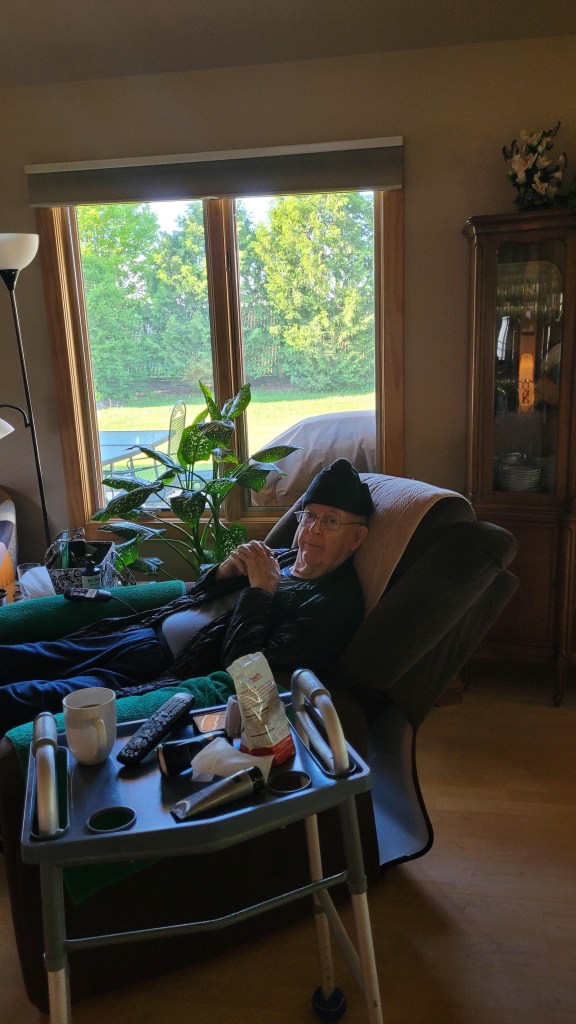
He has three places in the house where he can be found – in bed, at the table and in his lift recliner. It is June but his stocking hat is what keeps him comfortable at night.
Yesterday’s thought provoking incident happened around supper time for us. The family had scheduled a Zoom conference to do some advance planning for our summer reunion. I came over to the husband who was sitting in his lift chair with the tv on, his eyes were closed. I told him I was going over to Mom’s house to help her get on the Zoom. She is always confused about computer events.
He opened his eyes and listened to me but had such a blank expression that I started over and reminded him of the details, the Zoom, of the reunion we were planning, and watched him get totally confused by it all. He said so, repeatedly.
“I’m confused. I don’t know, I’m just confused.”
He couldn’t find more words to describe his mental state, and that alone was causing him concern. I could see that he was getting frightened.
“Can we pray about it?” He finally asked, shaking his head. So we did.
He then decided that the best thing would be to go back to his bed, even though he had only been up about half an hour from his last nap. I watched him closely as he went to the bathroom, took off his glasses and hearing aids and laid down. He was a bit confused even in that routine. But he slept for a couple hours, got up and ate supper, and apparently felt more himself.
What was going on there? I don’t know. But I realized that I was past the point of rushing him to the ER for stroke intervention, or any other kind of help. He didn’t ask to go either. Weird changes have become so normal. Some of them I’ve just read about and others have actually happened to us. Once he told me he couldn’t see the food on his plate and wondered what was happening to his eyes. Other times he has decided not to go out to church, which he normally loves to do, because he is feeling “foggy” or hasn’t had a good night.
I wish I could have the conversation with him about what he does want to have done at times like this. The trouble is, he still hopes for a touch from God to take away this disease. He wants to live…. Who wouldn’t, if they were well. I wonder if he would understand that I think the hospital would only prolong his life with LBD. I wonder if he would agree that his present state is not the picture of quality life. I wonder if he would feel like he has lost his advocate.
If God plans to heal him of this dementia, couldn’t he also heal him of a stroke, or an infection, or any other life threatening ailment? He could, and I am content to let him (God) decide when those things come up, without outside interference. But what kind of caregiver, what kind of wife, does that make me? I’m just not sure. I think God and I are at peace with him giving me directions for these scary moments. I will need a nudge one way or another. I will need help in not feeling judged for my decisions.
Yesterday I sat down with a cup of tea and a cookie. I thought and thought about these things and all I could come up with, as I finished the last crumbs, was that I needed another cookie.
I’ve just read a post in the online support group for dementia caretakers that made me think. It was about how those with a diagnosis of LBD, who have been good friends with many in better years, don’t hear from their friends any more. Actually it was a caretaker writing the post, who was sad that the friends didn’t even contact her to ask how her husband was. She was wondering what their excuses were. Were they unable to handle the changes they saw in him? Were they afraid dementia was contagious, or that they would somehow get it? Did they think that their absence wouldn’t be noticed by anyone so why bother?
My husband who has Lewy Body Dementia is probably not your typical dementia victim, because he has refused to let people forget him. He calls them up if he knows their number. He hunts them down if he doesn’t know their number. He calls them again if they don’t answer the first, second, or third time he calls. He checks up on them even if they don’t check up on him. He remembers what they’ve talked about. These people are his past business associates, the members of the band he used to play in, and family members.
Many times I’ve listened to the conversations (he is always in the living room and doesn’t try to keep them private). Sometimes I cringe when I hear him repeating the same story to someone who has heard it all before. Sometimes I feel sorry for the person he calls because he talks so slowly and often has trouble hearing. Sometimes I wish he wouldn’t try to sound like an authority about other people’s problems, or misquote things he’s read, or be so simplistic about things I think are much more complex. But at the end of it all, I see that there are those people who do take his calls anyway. There are some who listen to his stories, even if somewhat impatiently, and respond with interest. Some tell him that he has encouraged them, given them hope. They are his telephone tribe.
I hear patience in their voices when they talk to him, laugh with him, ask him questions. When they don’t have time for his hour long versions, they tell him they need to go in a few minutes. They set limits in kind ways and show respect. They call him back when they say they will or apologize if they forget. They continue being good friends. They know they are doing something for him that friendship is supposed to do, and they are not afraid, not too busy, not “turned off” by the changes dementia has brought to him. I am so thankful for those friends, because they also help me. I am thankful to have married a man who chose his friends wisely. If you are this kind of friend, thank you.




 Hope in the Face of Dementia